Ashes taste Sweet and Salty 學到更多
In ception Is Im plyed Im plicitly In Ception it Celf
Whence aka Self Referential set is non complete without aka reference to
aka self providing aka completeness whence aka complesets contain aka completontainers

Istock.com / Thoth_Adan
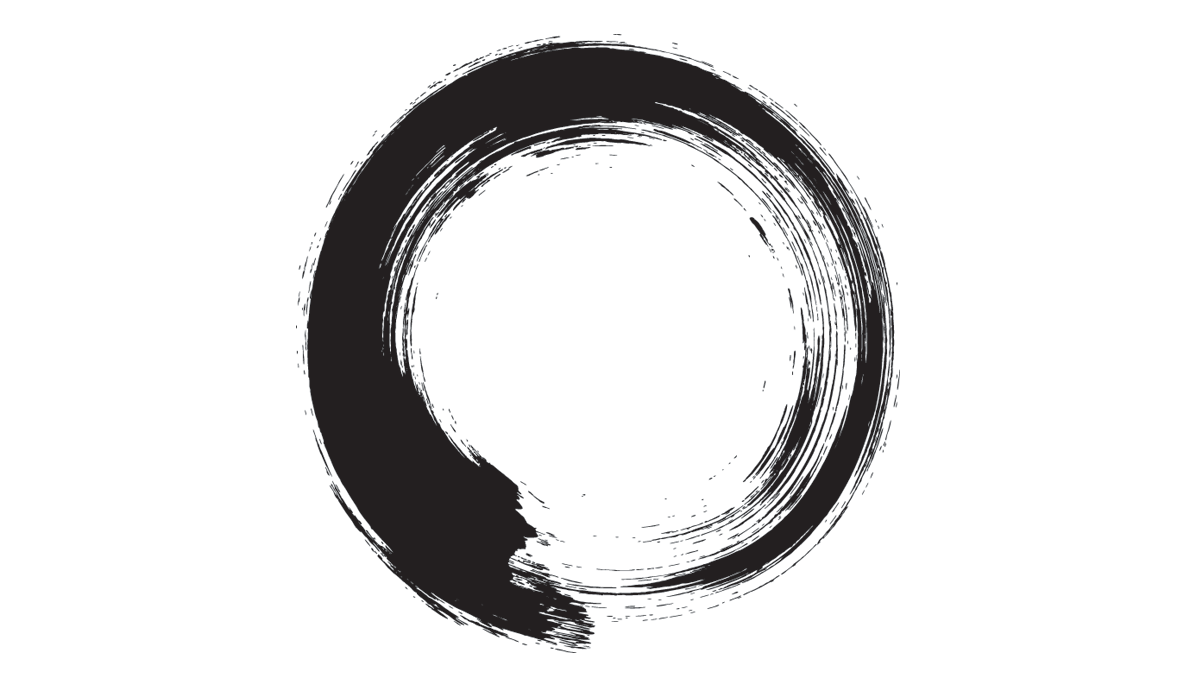
What is an Enso?
BY JOHN STEVENS|
Enso as defined by John Stevens, author of Sacred Calligraphy of the East.
a Japanese word meaning “circular form” and usually translated into English as “Zen circle,” is the symbol 禅庭 Zen niwa supreme of Buddhist enlightenment. 仏教の悟りの至高 Bukkyō no satori no shikō...Right from the beginning of the Buddhist tradition, enlightenment was compared to the “bright full moon” and a “great round mirror.” In the biography of the Prajnaparamita master Nagarjuna, it states that whenever he taught in public, the master would appear as a luminous circle in order to reveal the true form of buddhanature: “Neither large nor small, neither wide nor narrow, neither good nor bad, neither transient nor eternal.” Bodhidharma, the grand patriarch of Zen, was called the “Great Teacher of Circle Enlightenment.” The Sixth Patriarch Huineng was said to have employed the use of ninety-six types of circles in his teachings. In the Shinjinmei, an early Zen text, the way of buddha is described as “a circle like vast space, lacking nothing, nothing in excess.” In short, an enso defines the Zen state of mind.
最高の悟り Saikō no satori 最高 Saikō... Enso can be written in the air, drawn in the dirt, or, most typically, brushed on paper. The first Zen painting 禅の絵 Zen no e was almost certainly an
絵を描く Ewokaku... enso, brushed for a student who needed something concrete to contemplate, a visual expression of enlightenment. The earliest known example of an enso painting is by the Chinese Zen Master Kyozan (814-890)

as recorded in the Keitokudento-roku...
sexta-feira, 31 de dezembro de 2010
The enso in Japanese art


sexta-feira, 31 de dezembro de 2010
The enso in Japanese art
The Zen symbol "supreme" is an enso, a circle of enlightenment. The Shinjinmei, written in the sixth century, refers to the Great Way of Zen as "A circle like vast space, lacking nothing, and nothing in excess," and this statement is often used as an inscription on enso paintings. The earliest reference to a written enso, the first Zen painting, occurs in the Keitokudento-roku, composed in the eighth century:
A monk asked Master Isan for a gatha expressing enlightenment. Isan refused saying, "It is right in front of your face, why should I express it in brush and ink?"
The monk then asked Kyozan, another master, for something concrete. Kyozan drew a circle on a piece of paper, and said, "Thinking about this is and then understanding it is second best; not thinking about it and understanding it is third best." (He did not say what is first best.)
Thereafter Zen circles became a central theme of Zen art. Enso range in shape from perfectly symmetrical to completely lopsided and in brushstroke (sometimes two brushstrokes) from thin and delicate to thick and massive. Most paintings have an accompanying inscription that gives the viewer a "hint" regarding the ultimate meaning of a particular Zen circle. The primary types of enso are: (1) Mirror enso: a simple circle, free of an accompanying inscription, leaving everything to the insight of the viewer. (2) Universe enso: a circle that represents the cosmos (modern physics also postulates curved space). (3) Moon enso: the full moon, clear and bright, silently illuminating all beings without discrimination, symbolizes Buddhist enlightenment. (4) Zero enso: in addition to being curved, time and space are "empty," yet they give birth to the fullness of existence. (5) Wheel enso: everything is subject to change, all life revolves in circles. (6)Sweet cake enso: Zen circles are profound but they are not abstract, and when enlightenment and the acts of daily life-"sipping tea and eating rice cakes"-are one, there is true Buddhism. (7) "What is this?" enso: the most frequently used inscription on Zen circle paintings, this is a pithy way of saying, "Don't let others fill your head with theories about Zen; discover the meaning for yourself!" via Shambala Zen Art Gallery
sexta-feira, 31 de dezembro de 2010
The enso in Japanese art
The Zen symbol "supreme" is an enso, a circle of enlightenment. The Shinjinmei, written in the sixth century, refers to the Great Way of Zen as "A circle like vast space, lacking nothing, and nothing in excess," and this statement is often used as an inscription on enso paintings. The earliest reference to a written enso, the first Zen painting, occurs in the Keitokudento-roku, composed in the eighth century:
A monk asked Master Isan for a gatha expressing enlightenment. Isan refused saying, "It is right in front of your face, why should I express it in brush and ink?"
The monk then asked Kyozan, another master, for something concrete. Kyozan drew a circle on a piece of paper, and said, "Thinking about this is and then understanding it is second best; not thinking about it and understanding it is third best." (He did not say what is first best.)
Thereafter Zen circles became a central theme of Zen art. Enso range in shape from perfectly symmetrical to completely lopsided and in brushstroke (sometimes two brushstrokes) from thin and delicate to thick and massive. Most paintings have an accompanying inscription that gives the viewer a "hint" regarding the ultimate meaning of a particular Zen circle. The primary types of enso are: (1) Mirror enso: a simple circle, free of an accompanying inscription, leaving everything to the insight of the viewer. (2) Universe enso: a circle that represents the cosmos (modern physics also postulates curved space). (3) Moon enso: the full moon, clear and bright, silently illuminating all beings without discrimination, symbolizes Buddhist enlightenment. (4) Zero enso: in addition to being curved, time and space are "empty," yet they give birth to the fullness of existence. (5) Wheel enso: everything is subject to change, all life revolves in circles. (6)Sweet cake enso: Zen circles are profound but they are not abstract, and when enlightenment and the acts of daily life-"sipping tea and eating rice cakes"-are one, there is true Buddhism. (7) "What is this?" enso: the most frequently used inscription on Zen circle paintings, this is a pithy way of saying, "Don't let others fill your head with theories about Zen; discover the meaning for yourself!" via Shambala Zen Art Gallery


Enso 禅 Zen 縫う Nuu 全祖 の上 No ue Zen sew
全部 Zenbu 武将 Bushō 場 書 Ba-sho 芭蕉 Baa show
食事 Shokuji 石 Ishi 色 Iro 形 Katachi 前の Mae Know
now 只今 Tada...
 円相 En-shō 演奏 Ensō
奇数を丸で囲みます
Questioner mouths words for the Dali Lama: Light is observed as a particle when seekers are looking for light in the dark as a particle this is the this that said seekers find and when seekers are looking for light as a wave under the light where the light was lost the seekers find waves of light the very waves said seekers dreamed of seeking in the darkness
 in a 350 page volume including index and bibliography the combination of letters MIND

Additional words mouthed by the speaker from a past life possibly according to the Daily Lambda seeking as the seekers seek what seekers only can be seeking due to the nature of their consciousnessing said consciousness into consciousness seekers find what seekers seek specifically as delineated eliccidatingly whence seekers of partikill light particol party particals are practically found and whence wave seeking seekers seek light waves in the heavieness of heaving heavenly hope for homegrown hoots waves are formed waves are floated waves waver waveringly wavy whispy whispered wavy gravy thus in the nonce that is sense for the daily dilemma light in all of the dreamy forms that light is able to manifest itself as in the light up brightly illuminated minds of the seekers ergo ed id seekers dream therefore light is consciousness Wala!

Watch it for your sweet self...

Color (American English) or colour (British English) is the visual perceptual property deriving from the spectrum of light interacting with the photoreceptor cells of the eyes. Color categories and physical specifications of color are associated with objects or materials based on their physical properties such as light absorption, reflection, or emission spectra. By defining a color space colors can be identified numerically by their coordinates.
Because perception of color stems from the varying spectral sensitivity of different types of cone cells in the retina to different parts of the spectrum, colors may be defined and quantified by the degree to which they stimulate these cells. These physical or physiological quantifications of color, however, do not fully explain the psychophysical perception of color appearance.
The science of color is sometimes called chromatics, colorimetry, or simply color science. It includes the perception of color by the human eye and brain, the origin of color in materials, color theory in art, and the physics of electromagnetic radiation in the visible range (that is, what is commonly referred to simply as light).
Difficult yes impossible no imagine the eager Easterner first walks left past the gorilla then appears to be as ignorant of the background as the easterner is of the foreground the work is a massacre not quite the current prize winner among mass care massacre given recent events yet the idea persists would it possibly be possible to remain gnorant unwissend in the Germanic the opposite of Ig Gnorant un interested in un unwisening ones self the beginning of the end of the nonsense idea that a double negative is not the way not to socrat the wrong concept with words which entertain rather than explain teasee Easy see

Corollary Non Asked Question:
They whoever
they are
say that
light is of differing colors Red Yellow Green Blue
And all hues combd combining a few
White supposedly representing the complete set
black supposedly representing the empty set
EVery day which is every night on the other side of the sideless orb wobbling around the sun like a wounded soldier and a wandering minstral take your pike for peeks
Atlas holds up the night sky for the Stars to breathe as the black holes get a little stuffy when the gas bags blow steam about said dreamy dreams
Mother shines the Wavy gravy Atlas bound for a round as round is defined by roundness when straight is the straight edge defined by the round pointedly as the part is always no greater than the point set said thusly thus particles are pointedly pointicles whence parted prom night from the party where all the waves part at the end to join the beginning comin round the mountain when she comes home
Thusly done as said wavy gravy Mother milkes self sent spent residue everywise wilst the orb of watery walter salts the sea somnambulently rockin too an fro washing the waste down below thusly sent from the sun to ward off all evil Day lights the night for the fortunate few as the other half is left to stew slumver sleep slumber sheep sip morning dew from the poppy plums pouting pasty poo porous precious peppery seed sun soaked through black as the night filled with light blue or white shinying in the night heat the beat says neatly sweet is the light taken not given whence the lovely milk of mother most makes manna money honey flow abxorb watery depth will work whence working down below reflected right white or not blue light not in the night when sea is white or black and tack is true azimuth tell you tell us thus counting the cost days to week months to minute movement makes moments memorable memoralized mostly moist mainly madder hatter wise mercury makes moonshine meek
Many moons later Energy is dissipated adjective
- 1. 道楽

Search Results
Main Results
The Energy released by the sunny is bouncy offy the moony just likeA itA bounceA offA theA HotA sideA ofA thA EarthyA see?
and some of said energy is passing through the surface of the water which is yet another non exist ant to begin with what happens
how much is there
what is the relationship between the hot water situation on the cold side of the Tiny Blue dot while the Hot side of the dot is in the dark dreaming about Atlas and the Redox is rocking the clock
Physics of color

| Color | Wavelength interval | Frequency interval | |
|---|---|---|---|
| Red | ~ 700–635 nm | ~ 430–480 THz | |
| Orange | ~ 635–590 nm | ~ 480–510 THz | |
| Yellow | ~ 590–560 nm | ~ 510–540 THz | |
| Green | ~ 560–520 nm | ~ 540–580 THz | |
| Cyan | ~ 520–490 nm | ~ 580–610 THz | |
| Blue | ~ 490–450 nm | ~ 610–670 THz | |
| Violet | ~ 450–400 nm | ~ 670–750 THz | |
| Color | (nm) | (THz) | (μm−1) | (eV) | (kJ mol−1) |
|---|---|---|---|---|---|
| Infrared | > 1000 | < 300 | < 1.00 | < 1.24 | < 120 |
| Red | 700 | 428 | 1.43 | 1.77 | 171 |
| Orange | 620 | 484 | 1.61 | 2.00 | 193 |
| Yellow | 580 | 517 | 1.72 | 2.14 | 206 |
| Green | 530 | 566 | 1.89 | 2.34 | 226 |
| Cyan | 500 | 600 | |||
| Blue | 470 | 638 | 2.13 | 2.64 | 254 |
| Violet (visible) | 420 | 714 | 2.38 | 2.95 | 285 |
| Near ultraviolet | 300 | 1000 | 3.33 | 4.15 | 400 |
| Far ultraviolet | < 200 | > 1500 | > 5.00 | > 6.20 | > 598 |


Electromagnetic radiation is characterized by its wavelength (or frequency) and its intensity. When the wavelength is within the visible spectrum (the range of wavelengths humans can perceive, approximately from 390 nm to 700 nm), it is known as "visible light".
Most light sources emit light at many different wavelengths; a source's spectrum is a distribution giving its intensity at each wavelength. Although the spectrum of light arriving at the eye from a given direction determines the color sensation in that direction, there are many more possible spectral combinations than color sensations. In fact, one may formally define a color as a class of spectra that give rise to the same color sensation, although such classes would vary widely among different species, and to a lesser extent among individuals within the same species. In each such class the members are called metamers of the color in question. This effect can be visualized by comparing the light sources' spectral power distributions and the resulting colors.


Comments
Post a Comment
Have something to say? Say it See it Feel it Live it then take It apart until you know what It is and As you were before you were born, feel the sound of it rattling around in the outbox smell the sight of it as the juices in your brain bag are fed little light waves of electric combinatory discombinatory salty sea solution sliding stealthily supplying the juice for the other end of the switch turned on by the turn on that turns on the on like one is when one is on and one is when one is idling on as the slumber soothes silky roads of well traversed travelers traipsing trails of tuned toned teeny tiny twirls of primes pumping nines into sixes and threes like humming honey bees evens evening out the odds as the unknown unknowns puddle sing a shiny bling and bring the ear funnel Z as close as eyeball close can see...z.z..z...