what is electric when electricity is atom antsy Certainly not Rarefaction

Rarefaction
 | This article needs additional citations for verification. (October 2012) |

Rarefaction is the reduction of an item's density, the opposite of compression.[1] Like compression, which can travel in waves (sound waves, for instance), rarefaction waves also exist in nature. A common rarefaction wave is the area of low relative pressure following a shock wave (see picture).
Rarefaction waves expand with time (much like sea waves spread out as they reach a beach); in most cases rarefaction waves keep the same overall profile ('shape') at all times throughout the wave's movement: it is a self-similar expansion. Each part of the wave travels at the local speed of sound, in the local medium. This expansion behaviour contrasts with that of pressure increases, which gets narrower with time until they steepen into shock waves.
Physical examples[edit source]
A natural example of rarefaction occurs in the layers of Earth's atmosphere. Because the atmosphere has mass, most atmospheric matter is nearer to the Earth due to the Earth's gravitation. Therefore, air at higher layers of the atmosphere is less dense, or rarefied, relative to air at lower layers. Thus rarefaction can refer either to a reduction in density over space at a single point of time, or a reduction of density over time for one particular area.
Rarefaction can be easily observed by compressing a spring and releasing it.


KEY CONCEPTS AND SUMMARY
VSEPR theory predicts the three-dimensional arrangement of atoms in a molecule. It states that valence electrons will assume an electron-pair geometry that minimizes repulsions between areas of high electron density (bonds and/or lone pairs). Molecular structure, which refers only to the placement of atoms in a molecule and not the electrons, is equivalent to electron-pair geometry only when there are no lone electron pairs around the central atom.
Glossary
bond angle: angle between any two covalent bonds that share a common atom
bond distance: (also, bond length) distance between the nuclei of two bonded atoms
electron-pair geometry: arrangement around a central atom of all regions of electron density (bonds, lone pairs, or unpaired electrons)
linear: shape in which two outside groups are placed on opposite sides of a central atom
molecular structure: structure that includes only the placement of the atoms in the molecule
tetrahedral: shape in which four outside groups are placed around a central atom such that a three-dimensional shape is generated with four corners and 109.5° angles between each pair and the central atom
trigonal planar: shape in which three outside groups are placed in a flat triangle around a central atom with 120° angles between each pair and the central atom
valence shell electron-pair repulsion theory (VSEPR): theory used to predict the bond angles in a molecule based on positioning regions of high electron density as far apart as possible to minimize electrostatic repulsion
vector: quantity having magnitude and direction
EXAMPLE 3: MOLECULAR SIMULATION
Using molecular shape simulator allows us to control whether bond angles and/or lone pairs are displayed by checking or unchecking the boxes under “Options” on the right. We can also use the “Name” checkboxes at bottom-left to display or hide the electron pair geometry (called “electron geometry” in the simulator) and/or molecular structure (called “molecular shape” in the simulator).
Build the molecule HCN in the simulator based on the following Lewis structure:
Click on each bond type or lone pair at right to add that group to the central atom. Once you have the complete molecule, rotate it to examine the predicted molecular structure. What molecular structure is this?
6.3 Molecular Shape
LEARNING OBJECTIVES
By the end of this section, you will be able to:
- Predict the structures of small molecules using valence shell electron pair repulsion (VSEPR) theory
Thus far, we have used two-dimensional Lewis structures to represent molecules. However, molecular structure is actually three-dimensional, and it is important to be able to describe molecular bonds in terms of their distances, angles, and relative arrangements in space (Figure 1). A bond angle is the angle between any two bonds that include a common atom, usually measured in degrees. A bond distance (or bond length) is the distance between the nuclei of two bonded atoms along the straight line joining the nuclei. Bond distances are measured in Ångstroms (1 Å = 10–10 m) or picometers (1 pm = 10–12 m, 100 pm = 1 Å).
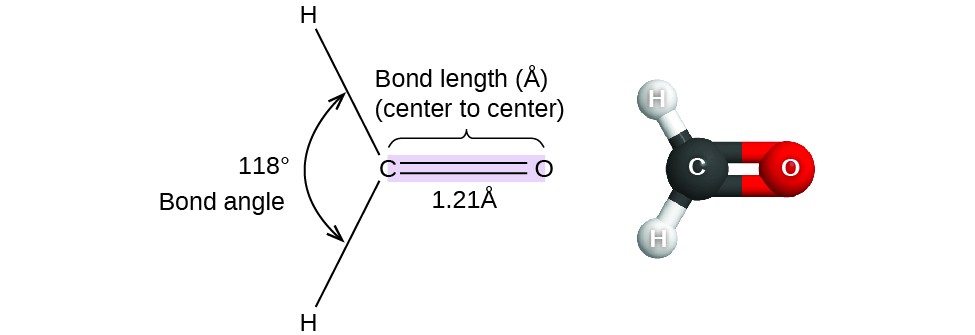
Figure 1. Bond distances (lengths) and angles are shown for the formaldehyde molecule, H2CO.
VSEPR Theory
Valence shell electron-pair repulsion theory (VSEPR theory) enables us to predict the molecular structure, including approximate bond angles around a central atom, of a molecule from an examination of the number of bonds and lone electron pairs in its Lewis structure. The VSEPR model assumes that electron pairs in the valence shell of a central atom will adopt an arrangement that minimizes repulsions between these electron pairs by maximizing the distance between them. The electrons in the valence shell of a central atom form either bonding pairs of electrons, located primarily between bonded atoms, or lone pairs. The electrostatic repulsion of these electrons is reduced when the various regions of high electron density assume positions as far from each other as possible.
VSEPR theory predicts the arrangement of electron pairs around each central atom and, usually, the correct arrangement of atoms in a molecule. We should understand, however, that the theory only considers electron-pair repulsions. Other interactions, such as nuclear-nuclear repulsions and nuclear-electron attractions, are also involved in the final arrangement that atoms adopt in a particular molecular structure.
?????????????????????????????????????????????????????????????????????????
ZZZZZZZZZZZZZZZZZZZZZZZZZZZZZZZZZZZZZZZZZZZZZZZZZZZZZZZZZZZZZZZZZZZ
As a simple example of VSEPR theory, let us predict the structure of a gaseous CO2 molecule. The Lewis structure of CO2 (Figure 2) shows only two electron pairs around the central carbon atom. With two bonds and no lone pairs of electrons on the central atom, the bonds are as far apart as possible, and the electrostatic repulsion between these regions of high electron density is reduced to a minimum when they are on opposite sides of the central atom. The bond angle is 180° (Figure 2). Figure 3 illustrates this and other electron-pair geometries that minimize the repulsions among regions of high electron density (bonds and/or lone pairs). Two regions of electron density around a central atom in a molecule form a linear geometry; three regions form a trigonal planar geometry; four regions form a tetrahedral geometry; five regions form a trigonal bipyramidal geometry; and six regions form an octahedral geometry.
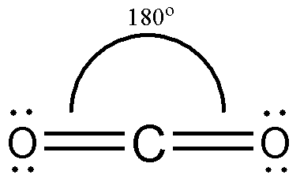
Figure 2. Carbon dioxide adopts a linear structure in which the two bonds are as far apart as possible, on opposite sides of the C atom
Second atmosphere
Outgassing from volcanism, supplemented by gases produced during the late heavy bombardment of Earth by huge asteroids, produced the next atmosphere, consisting largely of nitrogen plus carbon dioxide and inert gases.[44] A major part of carbon-dioxide emissions dissolved in water and reacted with metals such as calcium and magnesium during weathering of crustal rocks to form carbonates that were deposited as sediments. Water-related sediments have been found that date from as early as 3.8 billion years ago.[45]
About 3.4 billion years ago, nitrogen formed the major part of the then stable "second atmosphere". The influence of life has to be taken into account rather soon in the history of the atmosphere because hints of early life-forms appear as early as 3.5 billion years ago.[46] How Earth at that time maintained a climate warm enough for liquid water and life, if the early Sun put out 30% lower solar radiance than today, is a puzzle known as the "faint young Sun paradox".
The geological record however shows a continuous relatively warm surface during the complete early temperature record of Earth – with the exception of one cold glacial phase about 2.4 billion years ago. In the late Archean Eon an oxygen-containing atmosphere began to develop, apparently produced by photosynthesizing cyanobacteria (see Great Oxygenation Event), which have been found as stromatolite fossils from 2.7 billion years ago. The early basic carbon isotopy (isotope ratio proportions) strongly suggests conditions similar to the current, and that the fundamental features of the carbon cycle became established as early as 4 billion years ago.
Ancient sediments in the Gabon dating from between about 2.15 and 2.08 billion years ago provide a record of Earth's dynamic oxygenation evolution. These fluctuations in oxygenation were likely driven by the Lomagundi carbon isotope excursion.[47]
Third atmosphere

The constant re-arrangement of continents by plate tectonics influences the long-term evolution of the atmosphere by transferring carbon dioxide to and from large continental carbonate stores. Free oxygen did not exist in the atmosphere until about 2.4 billion years ago during the Great Oxygenation Event and its appearance is indicated by the end of the banded iron formations.
Before this time, any oxygen produced by photosynthesis was consumed by the oxidation of reduced materials, notably iron. Free oxygen molecules did not start to accumulate in the atmosphere until the rate of production of oxygen began to exceed the availability of reducing materials that removed oxygen. This point signifies a shift from a reducing atmosphere to an oxidizing atmosphere. O2 showed major variations until reaching a steady state of more than 15% by the end of the Precambrian.[50] The following time span from 539 million years ago to the present day is the Phanerozoic Eon, during the earliest period of which, the Cambrian, oxygen-requiring metazoan life forms began to appear.
The amount of oxygen in the atmosphere has fluctuated over the last 600 million years, reaching a peak of about 30% around 280 million years ago, significantly higher than today's 21%. Two main processes govern changes in the atmosphere: Plants using carbon dioxide from the atmosphere and releasing oxygen, and then plants using some oxygen at night by the process of photorespiration while the remaining oxygen is used to break down organic material. Breakdown of pyrite and volcanic eruptions release sulfur into the atmosphere, which reacts with oxygen and hence reduces its amount in the atmosphere. However, volcanic eruptions also release carbon dioxide, which plants can convert to oxygen. The cause of the variation of the amount of oxygen in the atmosphere is not known. Periods with much oxygen in the atmosphere are associated with the rapid development of animals.Atmosphere of Earth


The atmosphere of Earth, commonly known as air, is the layer of gases retained by Earth's gravity that surrounds the planet and forms its planetary atmosphere. The atmosphere of Earth protects life on Earth by creating pressure allowing for liquid water to exist on the Earth's surface, absorbing ultraviolet solar radiation, warming the surface through heat retention (greenhouse effect), and reducing temperature extremes between day and night (the diurnal temperature variation).
By mole fraction (i.e., by number of molecules), dry air contains 78.08% nitrogen, 20.95% oxygen, 0.93% argon, 0.04% carbon dioxide, and small amounts of other gases.[8] Air also contains a variable amount of water vapor, on average around 1% at sea level, and 0.4% over the entire atmosphere. Air composition, temperature, and atmospheric pressure vary with altitude. Within the atmosphere, air suitable for use in photosynthesis by terrestrial plants and breathing of terrestrial animals is found only in Earth's troposphere.[citation needed]
Earth's early atmosphere consisted of gases in the solar nebula, primarily hydrogen. The atmosphere changed significantly over time, affected by many factors such as volcanism, life, and weathering. Recently, human activity has also contributed to atmospheric changes, such as global warming, ozone depletion and acid deposition.
The atmosphere has a mass of about 5.15×10¹⁸ kg,[9] three quarters of which is within about 11 km (6.8 mi; 36,000 ft) of the surface. The atmosphere becomes thinner with increasing altitude, with no definite boundary between the atmosphere and outer space. The Kármán line, at 100 km (62 mi) or 1.57% of Earth's radius, is often used as the border between the atmosphere and outer space. Atmospheric effects become noticeable during atmospheric reentry of spacecraft at an altitude of around 120 km (75 mi). Several layers can be distinguished in the atmosphere, based on characteristics such as temperature and composition.
The study of Earth's atmosphere and its processes is called atmospheric science (aerology), and includes multiple subfields, such as climatology and atmospheric physics. Early pioneers in the field include Léon Teisserenc de Bort and Richard Assmann.[10] The study of historic atmosphere is called paleoclimatolo.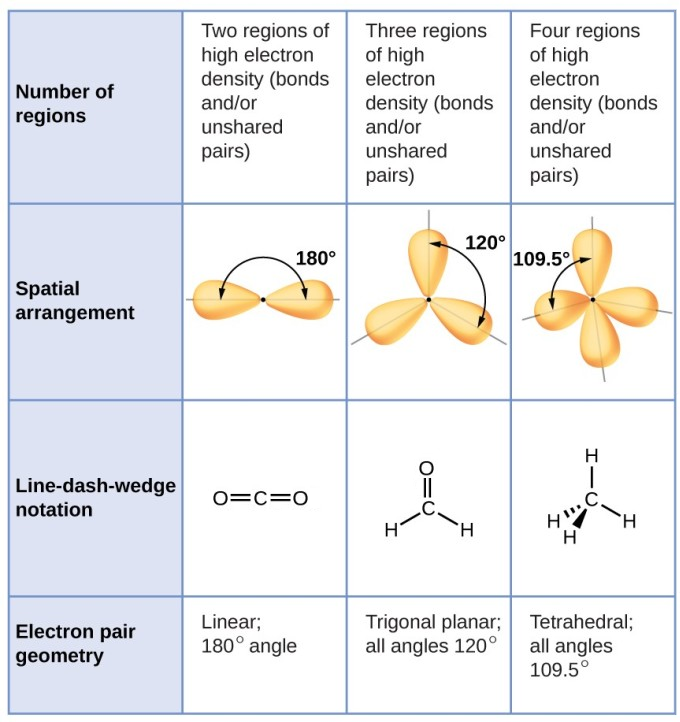
Figure 3 Basic electron-pair geometries predicted by VSEPR theory maximize the space around any region of electron density (bonds or lone pairs).
Electron-Pair Geometry versus Molecular Structure
It is important to note that electron-pair geometry around a central atom is not the same thing as its molecular structure. The electron-pair geometries shown in Figure 3 describe all regions where electrons are located, bonds as well as lone pairs. Molecular structure describes the location of the atoms, not the electrons.
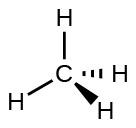
Figure 4. The molecular structure of the methane molecule, CH4, is shown with a tetrahedral arrangement of the hydrogen atoms.
We differentiate between these two situations by naming the geometry that includes all electron pairs the electron-pair geometry. The structure that includes only the placement of the atoms in the molecule is called the molecular structure. The electron-pair geometries will be the same as the molecular structures when there are no lone electron pairs around the central atom, but they will be different when there are lone pairs present on the central atom.
VSEPR structures like the one in Figure 4 are often drawn using the wedge and dash notation, in which solid lines represent bonds in the plane of the page, solid wedges represent bonds coming up out of the plane, and dashed lines represent bonds going down into the plane. For example, the methane molecule, CH4, which is the major component of natural gas, has four bonding pairs of electrons around the central carbon atom; the electron-pair geometry is tetrahedral, as is the molecular structure (Figure 4). On the other hand, the ammonia molecule, NH3, also has four electron pairs associated with the nitrogen atom, and thus has a tetrahedral electron-pair geometry. One of these regions, however, is a lone pair, which is not included in the molecular structure, and this lone pair influences the shape of the molecule (Figure 5).
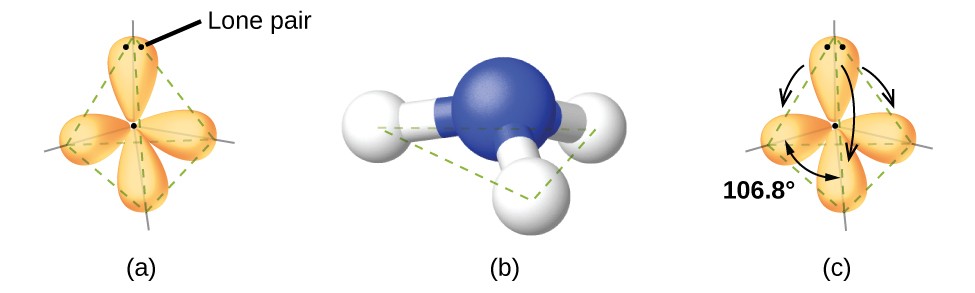
Figure 5. (a) The electron-pair geometry for the ammonia molecule is tetrahedral with one lone pair and three single bonds. (b) The trigonal pyramidal molecular structure is determined from the electron-pair geometry. (c) The actual bond angles deviate slightly from the idealized angles, because the lone pair takes up a larger region of space than do the single bonds, causing the HNH angle to be slightly smaller than 109.5°.
As seen in Figure 5, small distortions from the ideal angles in Figure 6 can result from differences in repulsion between various regions of electron density. VSEPR theory predicts these distortions by establishing an order of repulsions and an order of the amount of space occupied by different kinds of electron pairs. The order of electron-pair repulsions from greatest to least repulsion is:
lone pair-lone pair > lone pair-bonding pair > bonding pair-bonding pair
This order of repulsions determines the amount of space occupied by different regions of electrons. A lone pair of electrons occupies a larger region of space than the electrons in a triple bond; in turn, electrons in a triple bond occupy more space than those in a double bond, and so on. The order of sizes from largest to smallest is:
lone pair > triple bond > double bond>single bond
Consider formaldehyde, H2CO, which is used as a preservative for biological and anatomical specimens (Figure 1). This molecule has regions of high electron density that consist of two single bonds and one double bond. The basic geometry is trigonal planar with 120° bond angles, but we see that the double bond causes slightly larger angles (121°), and the angle between the single bonds is slightly smaller (118°).
In the ammonia molecule, the three hydrogen atoms attached to the central nitrogen are not arranged in a flat, trigonal planar molecular structure, but rather in a three-dimensional trigonal pyramid (Figure 5) with the nitrogen atom at the apex and the three hydrogen atoms forming the base. The ideal bond angles in a trigonal pyramid are based on the tetrahedral electron pair geometry. Again, there are slight deviations from the ideal because lone pairs occupy larger regions of space than do bonding electrons. The H–N–H bond angles in NH3 are slightly smaller than the 109.5° angle in a regular tetrahedron (Figure 3) because the lone pair-bonding pair repulsion is greater than the bonding pair-bonding pair repulsion (Figure 5). Figure 6 illustrates the ideal molecular structures, which are predicted based on the electron-pair geometries for various combinations of lone pairs and bonding pairs.
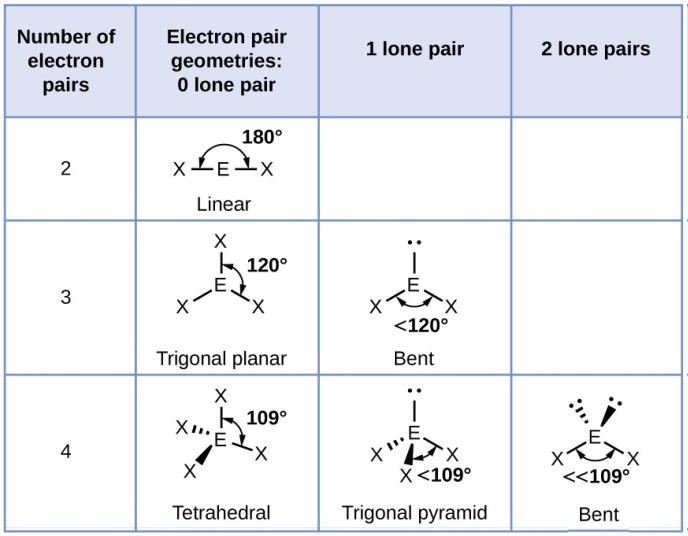
Figure 6. The molecular structures are identical to the electron-pair geometries when there are no lone pairs present (first column). For a particular number of electron pairs (row), the molecular structures for one or more lone pairs are determined based on modifications of the corresponding electron-pair geometry.
According to VSEPR theory, the terminal atom locations (Xs in Figure 6) are equivalent within the linear, trigonal planar, and tetrahedral electron-pair geometries (the first three rows of the table). It does not matter which X is replaced with a lone pair, because the molecules can be rotated to convert positions.
Composition

The three major constituents of Earth's atmosphere are nitrogen, oxygen, and argon. Water vapor accounts for roughly 0.25% of the atmosphere by mass. The concentration of water vapor (a greenhouse gas) varies significantly from around 10 ppm by mole fraction in the coldest portions of the atmosphere to as much as 5% by mole fraction in hot, humid air masses, and concentrations of other atmospheric gases are typically quoted in terms of dry air (without water vapor).[11]: 8 The remaining gases are often referred to as trace gases,[12] among which are other greenhouse gases, principally carbon dioxide, methane, nitrous oxide, and ozone. Besides argon, already mentioned, other noble gases, neon, helium, krypton, and xenon are also present. Filtered air includes trace amounts of many other chemical compounds. Many substances of natural origin may be present in locally and seasonally variable small amounts as aerosols in an unfiltered air sample, including dust of mineral and organic composition, pollen and spores, sea spray, and volcanic ash. Various industrial pollutants also may be present as gases or aerosols, such as chlorine (elemental or in compounds), fluorine compounds and elemental mercury vapor. Sulfur compounds such as hydrogen sulfide and sulfur dioxide (SO2) may be derived from natural sources or from industrial air pollution.
| Gas | Mole fraction(A) | ||
|---|---|---|---|
| Name | Formula | in ppm(B) | in % |
| Nitrogen | N2 | 780,840 | 78.084 |
| Oxygen | O2 | 209,460 | 20.946 |
| Argon | Ar | 9,340 | 0.9340 |
| Carbon dioxide (April, 2022)(C)[13] | CO2 | 417 | 0.0417 |
| Neon | Ne | 18.18 | 0.001818 |
| Helium | He | 5.24 | 0.000524 |
| Methane | CH4 | 1.87 | 0.000187 |
| Krypton | Kr | 1.14 | 0.000114 |
| Not included in above dry atmosphere: | |||
| Water vapor(D) | H2O | 0–30,000(D) | 0–3%(E) |
notes:
| |||
The average molecular weight of dry air, which can be used to calculate densities or to convert between mole fraction and mass fraction, is about 28.946[14] or 28.96[15][16] g/mol. This is decreased when the air is humid.
The relative concentration of gases remains constant until about 10,000 m (33,000 ft).[17]

Stratification

[18]In general, air pressure and density decrease with altitude in the atmosphere. However, the temperature has a more complicated profile with altitude, and may remain relatively constant or even increase with altitude in some regions (see the temperature section, below). Because the general pattern of the temperature/altitude profile, or lapse rate, is constant and measurable by means of instrumented balloon soundings, the temperature behavior provides a useful metric to distinguish atmospheric layers. In this way, Earth's atmosphere can be divided (called atmospheric stratification) into five main layers: troposphere, stratosphere, mesosphere, thermosphere, and exosphere.[19] The altitudes of the five layers are as follows:
- Exosphere: 700 to 10,000 km (440 to 6,200 miles)[20]
- Thermosphere: 80 to 700 km (50 to 440 miles)[21]
- Mesosphere: 50 to 80 km (31 to 50 miles)
- Stratosphere: 12 to 50 km (7 to 31 miles)
- Troposphere: 0 to 12 km (0 to 7 miles)[22]
Exosphere
The exosphere is the outermost layer of Earth's atmosphere (i.e. the upper limit of the atmosphere). It extends from the thermopause, at the top of the thermosphere at an altitude of about 700 km above sea level, to about 10,000 km (6,200 mi; 33,000,000 ft), where it merges into the solar wind.[20]
This layer is mainly composed of extremely low densities of hydrogen, helium and several heavier molecules including nitrogen, oxygen and carbon dioxide closer to the exobase. The atoms and molecules are so far apart that they can travel hundreds of kilometers without colliding with one another. Thus, the exosphere no longer behaves like a gas, and the particles constantly escape into space. These free-moving particles follow ballistic trajectories and may migrate in and out of the magnetosphere or the solar wind.
The exosphere is too far above Earth for meteorological phenomena to be possible. However, Earth's auroras—the aurora borealis (northern lights) and aurora australis (southern lights)—sometimes occur in the lower part of the exosphere, where they overlap into the thermosphere. The exosphere contains many of the artificial satellites that orbit Earth.
Thermosphere
The thermosphere is the second-highest layer of Earth's atmosphere. It extends from the mesopause (which separates it from the mesosphere) at an altitude of about 80 km (50 mi; 260,000 ft) up to the thermopause at an altitude range of 500–1000 km (310–620 mi; 1,600,000–3,300,000 ft). The height of the thermopause varies considerably due to changes in solar activity.[21] Because the thermopause lies at the lower boundary of the exosphere, it is also referred to as the exobase. The lower part of the thermosphere, from 80 to 550 kilometres (50 to 342 mi) above Earth's surface, contains the ionosphere.
The temperature of the thermosphere gradually increases with height and can rise as high as 1500 °C (2700 °F), though the gas molecules are so far apart that its temperature in the usual sense is not very meaningful. The air is so rarefied that an individual molecule (of oxygen, for example) travels an average of 1 kilometre (0.62 mi; 3300 ft) between collisions with other molecules.[23] Although the thermosphere has a high proportion of molecules with high energy, it would not feel hot to a human in direct contact, because its density is too low to conduct a significant amount of energy to or from the skin.
This layer is completely cloudless and free of water vapor. However, non-hydrometeorological phenomena such as the aurora borealis and aurora australis are occasionally seen in the thermosphere. The International Space Station orbits in this layer, between 350 and 420 km (220 and 260 mi). It is this layer where many of the satellites orbiting the earth are present.
Mesosphere
The mesosphere is the third highest layer of Earth's atmosphere, occupying the region above the stratosphere and below the thermosphere. It extends from the stratopause at an altitude of about 50 km (31 mi; 160,000 ft) to the mesopause at 80–85 km (50–53 mi; 260,000–280,000 ft) above sea level.
Temperatures drop with increasing altitude to the mesopause that marks the top of this middle layer of the atmosphere. It is the coldest place on Earth and has an average temperature around −85 °C (−120 °F; 190 K).[24][25]
Just below the mesopause, the air is so cold that even the very scarce water vapor at this altitude can sublimate into polar-mesospheric noctilucent clouds of ice particles. These are the highest clouds in the atmosphere and may be visible to the naked eye if sunlight reflects off them about an hour or two after sunset or similarly before sunrise. They are most readily visible when the Sun is around 4 to 16 degrees below the horizon. Lightning-induced discharges known as transient luminous events (TLEs) occasionally form in the mesosphere above tropospheric thunderclouds. The mesosphere is also the layer where most meteors burn up upon atmospheric entrance. It is too high above Earth to be accessible to jet-powered aircraft and balloons, and too low to permit orbital spacecraft. The mesosphere is mainly accessed by sounding rockets and rocket-powered aircraft.
Stratosphere
| Caterpillar | |
|---|---|
| Alice character | |
 The Caterpillar using a hookah; an illustration by John Tenniel. The illustration is noted for its ambiguous central figure, whose head can be viewed as being a human male's face with a pointed nose and protruding chin or being the head end of an actual caterpillar, with two "true" legs visible.[1] | |
| First appearance | Alice's Adventures in Wonderland |
| Created by | Lewis Carroll |
| In-universe information | |
| Alias | Hookah-Smoking Caterpillar, Absolem |
| Nickname | The Blue Caterpillar |
| Species | Caterpillar |
| Gender | Male |
| Nationality | Wonderland |
In the book[edit source]
Introduced in Chapter Four ("Rabbit Sends in a Little Bill") and the main center of interest of Chapter V ("Advice from a Caterpillar"), the Caterpillar is a hookah-smoking caterpillar exactly three inches high (a height, the virtues of which, he defends against Alice's complaint). Alice does not like the Caterpillar when they first meet, because he does not immediately talk to her and when he does, it is usually in short, rather rude sentences, or difficult questions.
The original illustration by John Tenniel is something of a visual paradox, wherein the caterpillar's human face appears to be formed from the head and legs of a naturalistic caterpillar.[1]
John Tenniel
John Tenniel | |
|---|---|
 Self-portrait of John Tenniel, c. 1889 | |
| Born | 28 February 1820 London, England |
| Died | 25 February 1914 (aged 93) London, England |
| Nationality | British |
| Known for | Illustration, Children's literature, Political cartoons |
Sir John Tenniel (/ˈtɛniəl/;[1] 28 February 1820 – 25 February 1914)[2] was an English illustrator, graphic humorist and political cartoonist prominent in the second half of the 19th century. He was knighted for artistic achievements in the 1893 Queen's Birthday Honours List. Tenniel is remembered mainly as the principal political cartoonist for Punch magazine for over 50 years and for his illustrations to Lewis Carroll's Alice's Adventures in Wonderland (1865) and Through the Looking-Glass, and What Alice Found There (1871).
Early life[edit source]

Tenniel was born in Bayswater, West London, to John Baptist Tenniel, a fencing and dancing master of Huguenot descent,[3][4] and Eliza Maria Tenniel. Tenniel had five siblings; two brothers and three sisters. One sister, Mary, was later to marry Thomas Goodwin Green, owner of the pottery that produced Cornishware. Tenniel was a quiet and introverted person, both as a boy and as an adult. He was content to remain firmly out of the limelight and seemed unaffected by competition or change. His biographer Rodney Engen wrote that Tenniel's "life and career was that of the supreme gentlemanly outside, living on the edge of respectability."[5]
In 1840, Tenniel, while practising fencing, received a serious eye wound from his father's foil, which had accidentally lost its protective tip. Over the years, Tenniel gradually lost sight in his right eye;[6] he never told his father of the severity of the wound, as he did not wish to upset him further.[7]
In spite of a tendency towards high art, Tenniel was already known and appreciated as a humorist. His early companionship with Charles Keene fostered his talent for scholarly caricature.[8][9]
Alice[edit source]
Despite the thousands of political cartoons and hundreds of illustrative works attributed to him, much of Tenniel's fame stems from his illustrations for Alice. Tenniel drew 92 drawings for Lewis Carroll's Alice's Adventures in Wonderland (London: Macmillan, 1865) and Through the Looking-Glass and What Alice Found There (London: Macmillan, 1871).
Lewis Carroll originally illustrated Wonderland himself, but his artistic abilities were limited. Engraver Orlando Jewitt, who had worked for Carroll in 1859 and reviewed Carroll's drawings for Wonderland, suggested that he employ a professional. Carroll was a regular reader of Punch and therefore familiar with Tenniel, who in 1865 had long talks with Carroll before illustrating the first edition of Alice's Adventures in Wonderland.

The first print run of 2,000 was sold in the United States, rather than England, because Tenniel objected to the print quality.[19] A new edition was released in December 1865, carrying an 1866 date, and became an instant best-seller, increasing Tenniel's fame. His drawings for both books have become some of the most famous literary illustrations. After 1872, when the Carroll projects were finished, Tenniel largely abandoned literary illustration. Carroll did later approach Tenniel to undertake another project for him. To this Tenniel replied:
Tenniel's Alice illustrations were engraved onto blocks of deal wood by the Brothers Dalziel. These then served as masters for the electrotype copies for the actual printing of the books.[21] The original wood blocks are held by the Bodleian Library in Oxford. They are not usually on public display, but were exhibited in 2003.[22]
The bronze Alice in Wonderland sculpture (1959) in Central Park in Manhattan, New York City, is patterned on his illustrations.[23][24]
Style[edit source]
Influence of German Nazarenes[edit source]
The style associated with the Nazarene movement of the 19th century influenced many later artists, including Tenniel. It can be characterised as "shaded outlines", where the lines on the side of figures or objects are given extra thickness or drawn double to suggest shading or volume.[25] Furthermore, this style is extremely precise, with the artist making a hard clear outline for its figures, dignifying them and the compositions, while giving restraint in expression and paleness of tone.[26] Though Tenniel's early illustrations in the Nazarene style were not well received, his encounter with the style pointed him in a good direction.[27]
Eye for detail[edit source]
After the 1850s, Tenniel's style was modernised to incorporate more detail in backgrounds and in figures. The inclusion of background details corrected the previously weak Germanic staging of his illustrations. Tenniel's more precisely-designed illustrations depicted specific moments of time, locale and individual character instead of just generalised scenes.[28]
In addition to a change in specificity of background, Tenniel developed a new interest in human types, expressions, and individualised representation, something that would carry over into his illustrations of Wonderland. Referred to by many as theatricality, this hallmark of Tenniel's style probably stemmed from his earlier interest in caricature. In Tenniel's first years on Punch he developed this caricaturist's interest in the uniqueness of persons and things, almost giving a human like personality to the objects in the environment.[29] For example, a comparison of one of John Everett Millais's illustrations of a girl in a chair with Tenniel's illustration of Alice in a chair shows clearly that Millais's chair is just a prop, whereas Tenniel's chair possesses a menacing and towering presence.
Another change in style was his shaded lines. These transformed from mechanical horizontal lines to vigorously hand-drawn hatching that greatly intensified darker areas.
Predicting Electron Pair Geometry and Molecular Structure
The following procedure uses VSEPR theory to determine the electron pair geometries and the molecular structures:
- Write the Lewis structure of the molecule or polyatomic ion.
- Count the number of regions of electron density (lone pairs and bonds) around the central atom. A single, double, or triple bond counts as one region of electron density.
- Identify the electron-pair geometry based on the number of regions of electron density: linear, trigonal planar, or tetrahedral. (Figure 6, first column).
- Use the number of lone pairs to determine the molecular structure (Figure 6). If more than one arrangement of lone pairs and chemical bonds is possible, choose the one that will minimize repulsions, remembering that lone pairs occupy more space than multiple bonds, which occupy more space than single bonds.
The following examples illustrate the use of VSEPR theory to predict the molecular structure of molecules or ions that have no lone pairs of electrons. In this case, the molecular structure is identical to the electron pair geometry.
Physical properties

Pressure and thickness
The average atmospheric pressure at sea level is defined by the International Standard Atmosphere as 101325 pascals (760.00 Torr; 14.6959 psi; 760.00 mmHg). This is sometimes referred to as a unit of standard atmospheres (atm). Total atmospheric mass is 5.1480×10¹⁸ kg (1.135×10¹⁹ lb),[38] about 2.5% less than would be inferred from the average sea level pressure and Earth's area of 51007.2 megahectares, this portion being displaced by Earth's mountainous terrain. Atmospheric pressure is the total weight of the air above unit area at the point where the pressure is measured. Thus air pressure varies with location and weather.
If the entire mass of the atmosphere had a uniform density equal to sea level density (about 1.2 kg per m3) from sea level upwards, it would terminate abruptly at an altitude of 8.50 km (27,900 ft).
Air pressure actually decreases exponentially with altitude, dropping by half every 5.6 km (18,000 ft) or by a factor of 1/e (0.368) every 7.64 km (25,100 ft), (this is called the scale height) -- for altitudes out to around 70 km (43 mi; 230,000 ft). However, the atmosphere is more accurately modeled with a customized equation for each layer that takes gradients of temperature, molecular composition, solar radiation and gravity into account. At heights over 100 km, an atmosphere may no longer be well mixed. Then each chemical species has its own scale height.
In summary, the mass of Earth's atmosphere is distributed approximately as follows:[39]
- 50% is below 5.6 km (18,000 ft).
- 90% is below 16 km (52,000 ft).
- 99.99997% is below 100 km (62 mi; 330,000 ft), the Kármán line. By international convention, this marks the beginning of space where human travelers are considered astronauts.
By comparison, the summit of Mt. Everest is at 8,848 m (29,029 ft); commercial airliners typically cruise between 10 and 13 km (33,000 and 43,000 ft) where the lower density and temperature of the air improve fuel economy; weather balloons reach 30.4 km (100,000 ft) and above; and the highest X-15 flight in 1963 reached 108.0 km (354,300 ft).
Even above the Kármán line, significant atmospheric effects such as auroras still occur. Meteors begin to glow in this region, though the larger ones may not burn up until they penetrate more deeply. The various layers of Earth's ionosphere, important to HF radio propagation, begin below 100 km and extend beyond 500 km. By comparison, the International Space Station and Space Shuttle typically orbit at 350–400 km, within the F-layer of the ionosphere where they encounter enough atmospheric drag to require reboosts every few months, otherwise, orbital decay will occur resulting in a return to Earth. Depending on solar activity, satellites can experience noticeable atmospheric drag at altitudes as high as 700–800 km.
Temperature

The division of the atmosphere into layers mostly by reference to temperature is discussed above. Temperature decreases with altitude starting at sea level, but variations in this trend begin above 11 km, where the temperature stabilizes over a large vertical distance through the rest of the troposphere. In the stratosphere, starting above about 20 km, the temperature increases with height, due to heating within the ozone layer caused by the capture of significant ultraviolet radiation from the Sun by the dioxygen and ozone gas in this region. Still another region of increasing temperature with altitude occurs at very high altitudes, in the aptly-named thermosphere above 90 km.
Speed of sound
Because in an ideal gas of constant composition the speed of sound depends only on temperature and not on pressure or density, the speed of sound in the atmosphere with altitude takes on the form of the complicated temperature profile (see illustration to the right), and does not mirror altitudinal changes in density or pressure.
Density and mass

The density of air at sea level is about 1.2 kg/m3 (1.2 g/L, 0.0012 g/cm3). Density is not measured directly but is calculated from measurements of temperature, pressure and humidity using the equation of state for air (a form of the ideal gas law). Atmospheric density decreases as the altitude increases. This variation can be approximately modeled using the barometric formula. More sophisticated models are used to predict the orbital decay of satellites.
The average mass of the atmosphere is about 5 quadrillion (5×10¹⁵) tonnes or 1/1,200,000 the mass of Earth. According to the American National Center for Atmospheric Research, "The total mean mass of the atmosphere is 5.1480×10¹⁸ kg with an annual range due to water vapor of 1.2 or 1.5×10¹⁵ kg, depending on whether surface pressure or water vapor data are used; somewhat smaller than the previous estimate. The mean mass of water vapor is estimated as 1.27×10¹⁶ kg and the dry air mass as 5.1352 ±0.0003×10¹⁸ kg."


Comments
Post a Comment
Have something to say? Say it See it Feel it Live it then take It apart until you know what It is and As you were before you were born, feel the sound of it rattling around in the outbox smell the sight of it as the juices in your brain bag are fed little light waves of electric combinatory discombinatory salty sea solution sliding stealthily supplying the juice for the other end of the switch turned on by the turn on that turns on the on like one is when one is on and one is when one is idling on as the slumber soothes silky roads of well traversed travelers traipsing trails of tuned toned teeny tiny twirls of primes pumping nines into sixes and threes like humming honey bees evens evening out the odds as the unknown unknowns puddle sing a shiny bling and bring the ear funnel Z as close as eyeball close can see...z.z..z...