Coronal Discharge Sounds Gooey
There are moments when a good current is good and there are moments when a good current is bad some of these moments are the same moment all depends on which side of the current one happens to be on if there is such a thing as sides when the current topic of conversation happens to be current
Currently there are a few wave forms flowing around here and there and here are a few ideas waving their forms formally founded on frinciples of Preedom
Wavefront
In physics, the wavefront of a time-varying wave field is the set (locus) of all points having the same phase.[1] The term is generally meaningful only for fields that, at each point, vary sinusoidally in time with a single temporal frequency (otherwise the phase is not well defined).
Wavefronts usually move with time. For waves propagating in an unidimensional medium, the wavefronts are usually single points; they are curves in a two dimensional medium, and surfaces in a three-dimensional one.


For a sinusoidal plane wave, the wavefronts are planes perpendicular to the direction of propagation, that move in that direction together with the wave. For a sinusoidal spherical wave, the wavefronts are spherical surfaces that expand with it. If the speed of propagation is different at different points of a wavefront, the shape and/or orientation of the wavefronts may change by refraction. In particular, lenses can change the shape of optical wavefronts from planar to spherical, or vice versa.
In classical physics, the diffraction phenomenon is described by the Huygens–Fresnel principle that treats each point in a propagating wavefront as a collection of individual spherical wavelets.[2] The characteristic bending pattern is most pronounced when a wave from a coherent source (such as a laser) encounters a slit/aperture that is comparable in size to its wavelength, as shown in the inserted image. This is due to the addition, or interference, of different points on the wavefront (or, equivalently, each wavelet) that travel by paths of different lengths to the registering surface. If there are multiple, closely spaced openings (e.g., a diffraction grating), a complex pattern of varying intensity can result.
Simple wavefronts and propagation[edit]
Optical systems can be described with Maxwell's equations, and linear propagating waves such as sound or electron beams have similar wave equations. However, given the above simplifications, Huygens' principle provides a quick method to predict the propagation of a wavefront through, for example, free space. The construction is as follows: Let every point on the wavefront be considered a new point source. By calculating the total effect from every point source, the resulting field at new points can be computed. Computational algorithms are often based on this approach. Specific cases for simple wavefronts can be computed directly. For example, a spherical wavefront will remain spherical as the energy of the wave is carried away equally in all directions. Such directions of energy flow, which are always perpendicular to the wavefront, are called rays creating multiple wavefronts.[3]

The simplest form of a wavefront is the plane wave, where the rays are parallel to one another. The light from this type of wave is referred to as collimated light. The plane wavefront is a good model for a surface-section of a very large spherical wavefront; for instance, sunlight strikes the earth with a spherical wavefront that has a radius of about 150 million kilometers (1 AU). For many purposes, such a wavefront can be considered planar over distances of the diameter of Earth.
Wavefronts travel with the speed of light in all directions in an isotropic medium.
Wavefront aberrations[edit]
Methods utilizing wavefront measurements or predictions can be considered an advanced approach to lens optics, where a single focal distance may not exist due to lens thickness or imperfections. For manufacturing reasons, a perfect lens has a spherical (or toroidal) surface shape though, theoretically, the ideal surface would be aspheric. Shortcomings such as these in an optical system cause what are called optical aberrations. The best-known aberrations include spherical aberration and coma.[4]
However there may be more complex sources of aberrations such as in a large telescope due to spatial variations in the index of refraction of the atmosphere. The deviation of a wavefront in an optical system from a desired perfect planar wavefront is called the wavefront aberration. Wavefront aberrations are usually described as either a sampled image or a collection of two-dimensional polynomial terms. Minimization of these aberrations is considered desirable for many applications in optical systems.
Sine wave
 | This article needs additional citations for verification. (May 2014) |

A sine wave, sinusoidal wave, or just sinusoid is a mathematical curve defined in terms of the sine trigonometric function, of which it is the graph. It is a type of continuous wave and also a smooth periodic function. It occurs often in mathematics, as well as in physics, engineering, signal processing and many other fields.
Formulation[edit]
Its most basic form as a function of time (t) is:

- A, amplitude, the peak deviation of the function from zero.
- f, ordinary frequency, the number of oscillations (cycles) that occur each second of time.
- ω = 2πf, angular frequency, the rate of change of the function argument in units of radians per second
- , phase, specifies (in radians) where in its cycle the oscillation is at t = 0.When is non-zero, the entire waveform appears to be shifted in time by the amount φ/ω seconds. A negative value represents a delay, and a positive value represents an advance.


The sine wave is important in physics because it retains its wave shape when added to another sine wave of the same frequency and arbitrary phase and magnitude. It is the only periodic waveform that has this property. This property leads to its importance in Fourier analysis and makes it acoustically unique.
General form[edit]
In general, the function may also have:
- a spatial variable x that represents the position on the dimension on which the wave propagates, and a characteristic parameter k called wave number (or angular wave number), which represents the proportionality between the angular frequency ω and the linear speed (speed of propagation) ν;
- a non-zero center amplitude, D
which is
- , if the wave is moving to the right
- , if the wave is moving to the left.


The wavenumber is related to the angular frequency by:
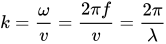
This equation gives a sine wave for a single dimension; thus the generalized equation given above gives the displacement of the wave at a position x at time t along a single line. This could, for example, be considered the value of a wave along a wire.
In two or three spatial dimensions, the same equation describes a travelling plane wave if position x and wavenumber k are interpreted as vectors, and their product as a dot product. For more complex waves such as the height of a water wave in a pond after a stone has been dropped in, more complex equations are needed.
Cosine[edit]
The term sinusoid describes any wave with characteristics of a sine wave. Thus, a cosine wave is also said to be sinusoidal, because , which is also a sine wave with a phase-shift of π/2 radians. Because of this head start, it is often said that the cosine function leads the sine function or the sine lags the cosine. The term sinusoidal thereby collectively refers to both sine waves and cosine waves with any phase offset.

Occurrence[edit]

This wave pattern occurs often in nature, including wind waves, sound waves, and light waves.
The human ear can recognize single sine waves as sounding clear because sine waves are representations of a single frequency with no harmonics.
To the human ear, a sound that is made of more than one sine wave will have perceptible harmonics; addition of different sine waves results in a different waveform and thus changes the timbre of the sound. Presence of higher harmonics in addition to the fundamental causes variation in the timbre, which is the reason why the same musical note (the same frequency) played on different instruments sounds different. On the other hand, if the sound contains aperiodic waves along with sine waves (which are periodic), then the sound will be perceived to be noisy, as noise is characterized as being aperiodic or having a non-repetitive pattern.
Fourier series[edit]

In 1822, French mathematician Joseph Fourier discovered that sinusoidal waves can be used as simple building blocks to describe and approximate any periodic waveform, including square waves. Fourier used it as an analytical tool in the study of waves and heat flow. It is frequently used in signal processing and the statistical analysis of time series.
Traveling and standing waves[edit]
Since sine waves propagate without changing form in distributed linear systems,[definition needed] they are often used to analyze wave propagation. Sine waves traveling in two directions in space can be represented as

When two waves having the same amplitude and frequency, and traveling in opposite directions, superpose each other, then a standing wave pattern is created. Note that, on a plucked string, the interfering waves are the waves reflected from the fixed endpoints of the string. Therefore, standing waves occur only at certain frequencies, which are referred to as resonant frequencies and are composed of a fundamental frequency and its higher harmonics. The resonant frequencies of a string are proportional to: the length between the fixed ends; the tension of the string; and inversely proportional to the mass per unit length of the string.
See also[edit]
- Crest (physics)
- Damped sine wave
Phase shift [edit]
The difference between the phases of two periodic signals and is called the phase difference or phase shift of relative to .[1] At values of when the difference is zero, the two signals are said to be in phase, otherwise they are out of phase with each other.
In the clock analogy, each signal is represented by a hand (or pointer) of the same clock, both turning at constant but possibly different speeds. The phase difference is then the angle between the two hands, measured clockwise.
The phase difference is particularly important when two signals are added together by a physical process, such as two periodic sound waves emitted by two sources and recorded together by a microphone. This is usually the case in linear systems, when the superposition principle holds.
For arguments when the phase difference is zero, the two signals will have the same sign and will be reinforcing each other. One says that constructive interference is occurring. At arguments when the phases are different, the value of the sum depends on the waveform.
For sinusoids[edit]
For sinusoidal signals, when the phase difference is 180° ( radians), one says that the phases are opposite, and that the signals are in antiphase. Then the signals have opposite signs, and destructive interference occurs. Conversely, a phase reversal or phase inversion implies a 180-degree phase shift.[2]
When the phase difference is a quarter of turn (a right angle, +90° = π/2 or −90° = 270° = −π/2 = 3π/2), sinusoidal signals are sometimes said to be in quadrature (e.g., in-phase and quadrature components).
If the frequencies are different, the phase difference increases linearly with the argument . The periodic changes from reinforcement and opposition cause a phenomenon called beating.
For shifted signal For sinusoids with same frequency[edit]
For sinusoidal signals (and a few other waveforms, like square or symmetric triangular), a phase shift of 180° is equivalent to a phase shift of 0° with negation of the amplitude. When two signals with these waveforms, same period, and opposite phases are added together, the sum is either identically zero, or is a sinusoidal signal with the same period and phase, whose amplitude is the difference of the original amplitudes.
The phase shift of the co-sine function relative to the sine function is +90°. It follows that, for two sinusoidal signals and with same frequency and amplitudes and , and has phase shift +90° relative to , the sum is a sinusoidal signal with the same frequency, with amplitude and phase shift from , such that
- and .
A real-world example of a sonic phase difference occurs in the warble of a Native American flute. The amplitude of different harmonic components of same long-held note on the flute come into dominance at different points in the phase cycle. The phase difference between the different harmonics can be observed on a spectrogram of the sound of a warbling flute.[4]
Phase comparison[edit]
Phase comparison is a comparison of the phase of two waveforms, usually of the same nominal frequency. In time and frequency, the purpose of a phase comparison is generally to determine the frequency offset (difference between signal cycles) with respect to a reference.[3]
A phase comparison can be made by connecting two signals to a two-channel oscilloscope. The oscilloscope will display two sine signals, as shown in the graphic to the right. In the adjacent image, the top sine signal is the test frequency, and the bottom sine signal represents a signal from the reference.
If the two frequencies were exactly the same, their phase relationship would not change and both would appear to be stationary on the oscilloscope display. Since the two frequencies are not exactly the same, the reference appears to be stationary and the test signal moves. By measuring the rate of motion of the test signal the offset between frequencies can be determined.
Vertical lines have been drawn through the points where each sine signal passes through zero. The bottom of the figure shows bars whose width represents the phase difference between the signals. In this case the phase difference is increasing, indicating that the test signal is lower in frequency than the reference.[3]
Formula for phase of an oscillation or a periodic signal[edit]
The phase of an oscillation or signal refers to a sinusoidal function such as the following:
where , , and are constant parameters called the amplitude, frequency, and phase of the sinusoid. These signals are periodic with period , and they are identical except for a displacement of along the axis. The term phase can refer to several different things:
- It can refer to a specified reference, such as , in which case we would say the phase of is , and the phase of is .
- It can refer to , in which case we would say and have the same phase but are relative to their own specific references.
- In the context of communication waveforms, the time-variant angle , or its principal value, is referred to as instantaneous phase, often just phase.
See also[edit]
- Absolute phase
- In-phase and quadrature components
- Instantaneous phase
- Lissajous curve
- Phase cancellation
- Phase problem
- Phase spectrum
- Phase velocity
- Phasor
- Polarization
- Coherence, the quality of a wave to display a well defined phase relationship in different regions of its domain of definition
- Hilbert Transform, A method of changing phase by 90°
- Reflection phase shift, A phase change that happens when a wave is reflected off of a boundary from fast medium to slow medium
References[edit]
- ^ a b Ballou, Glen (2005). Handbook for sound engineers (3 ed.). Focal Press, Gulf Professional Publishing. p. 1499. ISBN 978-0-240-80758-4.
- ^ "Federal Standard 1037C: Glossary of Telecommunications Terms".
- ^ a b c Time and Frequency from A to Z (2010-05-12). "Phase". National Institute of Standards and Technology (NIST). Retrieved 12 June 2016. This content has been copied and pasted from an NIST web page and is in the public domain.
- ^ Clint Goss; Barry Higgins (2013). "The Warble". Flutopedia. Retrieved 2013-03-06.

Mathematical definition[edit]
Let be a periodic signal (that is, a function of one real variable), and be its period (that is, the smallest positive real number such that for all ). Then the phase of at any argument is
Here denotes the fractional part of a real number, discarding its integer part; that is, ; and is an arbitrary "origin" value of the argument, that one considers to be the beginning of a cycle.
This concept can be visualized by imagining a clock with a hand that turns at constant speed, making a full turn every seconds, and is pointing straight up at time . The phase is then the angle from the 12:00 position to the current position of the hand, at time , measured clockwise.
The phase concept is most useful when the origin is chosen based on features of . For example, for a sinusoid, a convenient choice is any where the function's value changes from zero to positive.
The formula above gives the phase as an angle in radians between 0 and . To get the phase as an angle between and , one uses instead
The phase expressed in degrees (from 0° to 360°, or from −180° to +180°) is defined the same way, except with "360°" in place of "2π".
Consequences[edit]
With any of the above definitions, the phase of a periodic signal is periodic too, with the same period :
- for all .
The phase is zero at the start of each period; that is
- for any integer .
Moreover, for any given choice of the origin , the value of the signal for any argument depends only on its phase at . Namely, one can write , where is a function of an angle, defined only for a single full turn, that describes the variation of as ranges over a single period.
In fact, every periodic signal with a specific waveform can be expressed as
where is a "canonical" function of a phase angle in 0 to 2π, that describes just one cycle of that waveform; and is a scaling factor for the amplitude. (This claim assumes that the starting time chosen to compute the phase of corresponds to argument 0 of .)
Adding and comparing phases[edit]
Since phases are angles, any whole full turns should usually be ignored when performing arithmetic operations on them. That is, the sum and difference of two phases (in degrees) should be computed by the formulas
- and
respectively. Thus, for example, the sum of phase angles 190° + 200° is 30° (190 + 200 = 390, minus one full turn), and subtracting 50° from 30° gives a phase of 340° (30 - 50 = −20, plus one full turn).
Similar formulas hold for radians, with instead of 360.
Phase shift [edit]
The difference between the phases of two periodic signals and is called the phase difference or phase shift of relative to .[1] At values of when the difference is zero, the two signals are said to be in phase, otherwise they are out of phase with each other.
In the clock analogy, each signal is represented by a hand (or pointer) of the same clock, both turning at constant but possibly different speeds. The phase difference is then the angle between the two hands, measured clockwise.
The phase difference is particularly important when two signals are added together by a physical process, such as two periodic sound waves emitted by two sources and recorded together by a microphone. This is usually the case in linear systems, when the superposition principle holds.
For arguments when the phase difference is zero, the two signals will have the same sign and will be reinforcing each other. One says that constructive interference is occurring. At arguments when the phases are different, the value of the sum depends on the waveform.
For sinusoids[edit]
For sinusoidal signals, when the phase difference is 180° ( radians), one says that the phases are opposite, and that the signals are in antiphase. Then the signals have opposite signs, and destructive interference occurs. Conversely, a phase reversal or phase inversion implies a 180-degree phase shift.[2]
When the phase difference is a quarter of turn (a right angle, +90° = π/2 or −90° = 270° = −π/2 = 3π/2), sinusoidal signals are sometimes said to be in quadrature (e.g., in-phase and quadrature components).
If the frequencies are different, the phase difference increases linearly with the argument . The periodic changes from reinforcement and opposition cause a phenomenon called beating.


Plasma (physics)
 This article may be too technical for most readers to understand. (March 2022)
Plasma (from Ancient Greek πλάσμα (plásma) 'moldable substance')[1] is one of the four fundamental states of matter. It contains a significant portion of charged particles – ions and/or electrons. The presence of these charged particles is what primarily sets plasma apart from the other fundamental states of matter. It is the most abundant form of ordinary matter in the universe,[2] being mostly associated with stars,[3] including the Sun.[4][5] It extends to the rarefied intracluster medium and possibly to intergalactic regions.[6] Plasma can be artificially generated by heating a neutral gas or subjecting it to a strong electromagnetic field.
The presence of charged particles makes plasma electrically conductive, with the dynamics of individual particles and macroscopic plasma motion governed by collective electromagnetic fields and very sensitive to externally applied fields.[7] The response of plasma to electromagnetic fields is used in many modern technological devices, such as plasma televisions or plasma etching.[8]
Depending on temperature and density, a certain amount of neutral particles may also be present, in which case plasma is called partially ionized. Neon signs and lightning are examples of partially ionized plasmas.[9] Unlike the phase transitions between the other three states of matter, the transition to plasma is not well defined and is a matter of interpretation and context.[10] Whether a given degree of ionization suffices to call a substance 'plasma' depends on the specific phenomenon being considered.

History of centrifugal and centripetal forces
In physics, the history of centrifugal and centripetal forces illustrates a long and complex evolution of thought about the nature of forces, relativity, and the nature of physical laws.
Contents
Huygens, Leibniz, Newton, and Hooke[edit]
Early scientific ideas about centrifugal force were based upon intuitive perception, and circular motion was considered somehow more "natural" than straight-line motion. According to Domenico Bertoloni-Meli:
- For Huygens and Newton centrifugal force was the result of a curvilinear motion of a body; hence it was located in nature, in the object of investigation. According to a more recent formulation of classical mechanics, centrifugal force depends on the choice of how phenomena can be conveniently represented. Hence it is not located in nature, but is the result of a choice by the observer. In the first case a mathematical formulation mirrors centrifugal force; in the second it creates it.[1]
Christiaan Huygens coined the term "centrifugal force" in his 1659 De Vi Centrifuga[2] and wrote of it in his 1673 Horologium Oscillatorium on pendulums. In 1676–77, Isaac Newton combined Kepler's laws of planetary motion with Huygens' ideas and found
Newton coined the term "centripetal force" (vis centripeta) in his discussions of gravity in his De motu corporum in gyrum, a 1684 manuscript which he sent to Edmond Halley.[4]
Gottfried Leibniz as part of his "solar vortex theory" conceived of centrifugal force as a real outward force which is induced by the circulation of the body upon which the force acts. An inverse cube law centrifugal force appears in an equation representing planetary orbits, including non-circular ones, as Leibniz described in his 1689 Tentamen de motuum coelestium causis.[5] Leibniz's equation is still used today to solve planetary orbital problems, although his solar vortex theory is no longer used as its basis.[6]
Leibniz produced an equation for planetary orbits in which the centrifugal force appeared as an outward inverse cube law force in the radial direction:[7]
- .
Newton himself appears to have previously supported an approach similar to that of Leibniz.[8] Later, Newton in his Principia crucially limited the description of the dynamics of planetary motion to a frame of reference in which the point of attraction is fixed. In this description, Leibniz's centrifugal force was not needed and was replaced by only continually inward forces toward the fixed point.[7] Newton objected to Leibniz's equation on the grounds that it allowed for the centrifugal force to have a different value from the centripetal force, arguing on the basis of his third law of motion, that the centrifugal force and the centripetal force must constitute an equal and opposite action-reaction pair. In this however, Newton was mistaken, as the reactive centrifugal force which is required by the third law of motion is a completely separate concept from the centrifugal force of Leibniz's equation.[8][9]
Huygens, who was, along with Leibniz, a neo-Cartesian and critic of Newton, concluded after a long correspondence that Leibniz's writings on celestial mechanics made no sense, and that his invocation of a harmonic vortex was logically redundant, because Leibniz's radial equation of motion follows trivially from Newton's laws. Even the most ardent modern defenders of the cogency of Leibniz's ideas acknowledge that his harmonic vortex as the basis of centrifugal force was dynamically superfluous.[10]
It has been suggested that the idea of circular motion as caused by a single force was introduced to Newton by Robert Hooke.[9]
Newton described the role of centrifugal force upon the height of the oceans near the equator in the Principia:
The effect of centrifugal force in countering gravity, as in this behavior of the tides, has led centrifugal force sometimes to be called "false gravity" or "imitation gravity" or "quasi-gravity".[11]
Eighteenth century[edit]
It wasn't until the latter half of the 18th century that the modern "fictitious force" understanding of the centrifugal force as a pseudo-force artifact of rotating reference frames took shape.[12] In a 1746 memoir by Daniel Bernoulli, "the idea that the centrifugal force is fictitious emerges unmistakably."[13] Bernoulli, in seeking to describe the motion of an object relative to an arbitrary point, showed that the magnitude of the centrifugal force depended on which arbitrary point was chosen to measure circular motion about. Later in the 18th century Joseph Louis Lagrange in his Mécanique Analytique explicitly stated that the centrifugal force depends on the rotation of a system of perpendicular axes.[13] In 1835, Gaspard-Gustave Coriolis analyzed arbitrary motion in rotating systems, specifically in relation to waterwheels. He coined the phrase "compound centrifugal force" for a term which bore a similar mathematical expression to that of centrifugal force, albeit that it was multiplied by a factor of two.[14] The force in question was perpendicular to both the velocity of an object relative to a rotating frame of reference and the axis of rotation of the frame. Compound centrifugal force eventually came to be known as the Coriolis Force.[15][16]
Absolute versus relative rotation[edit]
The idea of centrifugal force is closely related to the notion of absolute rotation. In 1707 the Irish bishop George Berkeley took issue with the notion of absolute space, declaring that "motion cannot be understood except in relation to our or some other body". In considering a solitary globe, all forms of motion, uniform and accelerated, are unobservable in an otherwise empty universe.[17] This notion was followed up in modern times by Ernst Mach. For a single body in an empty universe, motion of any kind is inconceivable. Because rotation does not exist, centrifugal force does not exist. Of course, addition of a speck of matter just to establish a reference frame cannot cause the sudden appearance of centrifugal force, so it must be due to rotation relative to the entire mass of the universe.[18] The modern view is that centrifugal force is indeed an indicator of rotation, but relative to those frames of reference that exhibit the simplest laws of physics.[19] Thus, for example, if we wonder how rapidly our galaxy is rotating, we can make a model of the galaxy in which its rotation plays a part. The rate of rotation in this model that makes the observations of (for example) the flatness of the galaxy agree best with physical laws as we know them is the best estimate of the rate of rotation[20] (assuming other observations are in agreement with this assessment, such as isotropy of the background radiation of the universe).[21]
Derivation[edit]
For the following formalism, the rotating frame of reference is regarded as a special case of a non-inertial reference frame that is rotating relative to an inertial reference frame denoted the stationary frame.
Time derivatives in a rotating frame[edit]
In a rotating frame of reference, the time derivatives of any vector function P of time—such as the velocity and acceleration vectors of an object—will differ from its time derivatives in the stationary frame. If P1 P2, P3 are the components of P with respect to unit vectors i, j, k directed along the axes of the rotating frame (i.e. P = P1 i + P2 j +P3 k), then the first time derivative [dP/dt] of P with respect to the rotating frame is, by definition, dP1/dt i + dP2/dt j + dP3/dt k. If the absolute angular velocity of the rotating frame is ω then the derivative dP/dt of P with respect to the stationary frame is related to [dP/dt] by the equation:[13]
where denotes the vector cross product. In other words, the rate of change of P in the stationary frame is the sum of its apparent rate of change in the rotating frame and a rate of rotation attributable to the motion of the rotating frame. The vector ω has magnitude ω equal to the rate of rotation and is directed along the axis of rotation according to the right-hand rule.
Acceleration[edit]
Newton's law of motion for a particle of mass m written in vector form is:
where F is the vector sum of the physical forces applied to the particle and a is the absolute acceleration (that is, acceleration in an inertial frame) of the particle, given by:
where r is the position vector of the particle.
By applying the transformation above from the stationary to the rotating frame three times (twice to and once to ), the absolute acceleration of the particle can be written as:
Force[edit]
The apparent acceleration in the rotating frame is . An observer unaware of the rotation would expect this to be zero in the absence of outside forces. However, Newton's laws of motion apply only in the inertial frame and describe dynamics in terms of the absolute acceleration . Therefore, the observer perceives the extra terms as contributions due to fictitious forces. These terms in the apparent acceleration are independent of mass; so it appears that each of these fictitious forces, like gravity, pulls on an object in proportion to its mass. When these forces are added, the equation of motion has the form:[14][15][16]
From the perspective of the rotating frame, the additional force terms are experienced just like the real external forces and contribute to the apparent acceleration.[17][18] The additional terms on the force side of the equation can be recognized as, reading from left to right, the Euler force , the Coriolis force , and the centrifugal force , respectively.[19] Unlike the other two fictitious forces, the centrifugal force always points radially outward from the axis of rotation of the rotating frame, with magnitude mω2r, and unlike the Coriolis force in particular, it is independent of the motion of the particle in the rotating frame. As expected, for a non-rotating inertial frame of reference the centrifugal force and all other fictitious forces disappear.[20] Similarly, as the centrifugal force is proportional to the distance from object to the axis of rotation of the frame, the centrifugal force vanishes for objects that lie upon the axis.
Absolute rotation[edit]
Three scenarios were suggested by Newton to answer the question of whether the absolute rotation of a local frame can be detected; that is, if an observer can decide whether an observed object is rotating or if the observer is rotating.[21][22]
- The shape of the surface of water rotating in a bucket. The shape of the surface becomes concave to balance the centrifugal force against the other forces upon the liquid.
- The tension in a string joining two spheres rotating about their center of mass. The tension in the string will be proportional to the centrifugal force on each sphere as it rotates around the common center of mass.
In these scenarios, the effects attributed to centrifugal force are only observed in the local frame (the frame in which the object is stationary) if the object is undergoing absolute rotation relative to an inertial frame. By contrast, in an inertial frame, the observed effects arise as a consequence of the inertia and the known forces without the need to introduce a centrifugal force. Based on this argument, the privileged frame, wherein the laws of physics take on the simplest form, is a stationary frame in which no fictitious forces need to be invoked.
Within this view of physics, any other phenomenon that is usually attributed to centrifugal force can be used to identify absolute rotation. For example, the oblateness of a sphere of freely flowing material is often explained in terms of centrifugal force. The oblate spheroid shape reflects, following Clairaut's theorem, the balance between containment by gravitational attraction and dispersal by centrifugal force. That the Earth is itself an oblate spheroid, bulging at the equator where the radial distance and hence the centrifugal force is larger, is taken as one of the evidences for its absolute rotation.[23]
Applications[edit]
The operations of numerous common rotating mechanical systems are most easily conceptualized in terms of centrifugal force. For example:
- A centrifugal governor regulates the speed of an engine by using spinning masses that move radially, adjusting the throttle, as the engine changes speed. In the reference frame of the spinning masses, centrifugal force causes the radial movement.
- A centrifugal clutch is used in small engine-powered devices such as chain saws, go-karts and model helicopters. It allows the engine to start and idle without driving the device but automatically and smoothly engages the drive as the engine speed rises. Inertial drum brake ascenders used in rock climbing and the inertia reels used in many automobile seat belts operate on the same principle.
- Centrifugal forces can be used to generate artificial gravity, as in proposed designs for rotating space stations. The Mars Gravity Biosatellite would have studied the effects of Mars-level gravity on mice with gravity simulated in this way.
- Spin casting and centrifugal casting are production methods that use centrifugal force to disperse liquid metal or plastic throughout the negative space of a mold.
Introduction[edit]
Centrifugal force is an outward force apparent in a rotating reference frame.[1][2][3] It does not exist when a system is described relative to an inertial frame of reference.
All measurements of position and velocity must be made relative to some frame of reference. For example, an analysis of the motion of an object in an airliner in flight could be made relative to the airliner, to the surface of the Earth, or even to the Sun.[4] A reference frame that is at rest (or one that moves with no rotation and at constant velocity) relative to the "fixed stars" is generally taken to be an inertial frame. Any system can be analyzed in an inertial frame (and so with no centrifugal force). However, it is often more convenient to describe a rotating system by using a rotating frame—the calculations are simpler, and descriptions more intuitive. When this choice is made, fictitious forces, including the centrifugal force, arise.
In a reference frame rotating about an axis through its origin, all objects, regardless of their state of motion, appear to be under the influence of a radially (from the axis of rotation) outward force that is proportional to their mass, to the distance from the axis of rotation of the frame, and to the square of the angular velocity of the frame.[5][6] This is the centrifugal force. As humans usually experience centrifugal force from within the rotating reference frame, e.g. on a merry-go-round or vehicle, this is much more well-known than centripetal force.
Motion relative to a rotating frame results in another fictitious force: the Coriolis force. If the rate of rotation of the frame changes, a third fictitious force (the Euler force) is required. These fictitious forces are necessary for the formulation of correct equations of motion in a rotating reference frame[7][8] and allow Newton's laws to be used in their normal form in such a frame (with one exception: the fictitious forces do not obey Newton's third law: they have no equal and opposite counterparts).[7] Newton's third law requires the counterparts to exist within the same frame of reference, hence centrifugal and centripetal force, which do not, are not action and reaction (as is sometimes erroneously contended).
Examples[edit]
Vehicle driving round a curve[edit]
A common experience that gives rise to the idea of a centrifugal force is encountered by passengers riding in a vehicle, such as a car, that is changing direction. If a car is traveling at a constant speed along a straight road, then a passenger inside is not accelerating and, according to Newton's second law of motion, the net force acting on them is therefore zero (all forces acting on them cancel each other out). If the car enters a curve that bends to the left, the passenger experiences an apparent force that seems to be pulling them towards the right. This is the fictitious centrifugal force. It is needed within the passengers' local frame of reference to explain their sudden tendency to start accelerating to the right relative to the car—a tendency which they must resist by applying a rightward force to the car (for instance, a frictional force against the seat) in order to remain in a fixed position inside. Since they push the seat toward the right, Newton's third law says that the seat pushes them towards the left. The centrifugal force must be included in the passenger's reference frame (in which the passenger remains at rest): it counteracts the leftward force applied to the passenger by the seat, and explains why this otherwise unbalanced force does not cause them to accelerate.[9] However, it would be apparent to a stationary observer watching from an overpass above that the frictional force exerted on the passenger by the seat is not being balanced; it constitutes a net force to the left, causing the passenger to accelerate toward the inside of the curve, as they must in order to keep moving with the car rather than proceeding in a straight line as they otherwise would. Thus the "centrifugal force" they feel is the result of a "centrifugal tendency" caused by inertia.[10] Similar effects are encountered in aeroplanes and roller coasters where the magnitude of the apparent force is often reported in "G's".
Stone on a string[edit]
If a stone is whirled round on a string, in a horizontal plane, the only real force acting on the stone in the horizontal plane is applied by the string (gravity acts vertically). There is a net force on the stone in the horizontal plane which acts toward the center.
In an inertial frame of reference, were it not for this net force acting on the stone, the stone would travel in a straight line, according to Newton's first law of motion. In order to keep the stone moving in a circular path, a centripetal force, in this case provided by the string, must be continuously applied to the stone. As soon as it is removed (for example if the string breaks) the stone moves in a straight line, as viewed from above. In this inertial frame, the concept of centrifugal force is not required as all motion can be properly described using only real forces and Newton's laws of motion.
In a frame of reference rotating with the stone around the same axis as the stone, the stone is stationary. However, the force applied by the string is still acting on the stone. If one were to apply Newton's laws in their usual (inertial frame) form, one would conclude that the stone should accelerate in the direction of the net applied force—towards the axis of rotation—which it does not do. The centrifugal force and other fictitious forces must be included along with the real forces in order to apply Newton's laws of motion in the rotating frame.
Earth[edit]
The Earth constitutes a rotating reference frame because it rotates once every 23 hours and 56 minutes around its axis. Because the rotation is slow, the fictitious forces it produces are often small, and in everyday situations can generally be neglected. Even in calculations requiring high precision, the centrifugal force is generally not explicitly included, but rather lumped in with the gravitational force: the strength and direction of the local "gravity" at any point on the Earth's surface is actually a combination of gravitational and centrifugal forces. However, the fictitious forces can be of arbitrary size. For example, in an Earth-bound reference system, the fictitious force (the net of Coriolis and centrifugal forces) is enormous and is responsible for the Sun orbiting around the Earth (in the Earth-bound reference system). This is due to the large mass and velocity of the Sun (relative to the Earth).
Weight of an object at the poles and on the equator[edit]
If an object is weighed with a simple spring balance at one of the Earth's poles, there are two forces acting on the object: the Earth's gravity, which acts in a downward direction, and the equal and opposite restoring force in the spring, acting upward. Since the object is stationary and not accelerating, there is no net force acting on the object and the force from the spring is equal in magnitude to the force of gravity on the object. In this case, the balance shows the value of the force of gravity on the object.
When the same object is weighed on the equator, the same two real forces act upon the object. However, the object is moving in a circular path as the Earth rotates and therefore experiencing a centripetal acceleration. When considered in an inertial frame (that is to say, one that is not rotating with the Earth), the non-zero acceleration means that force of gravity will not balance with the force from the spring. In order to have a net centripetal force, the magnitude of the restoring force of the spring must be less than the magnitude of force of gravity. Less restoring force in the spring is reflected on the scale as less weight — about 0.3% less at the equator than at the poles.[11] In the Earth reference frame (in which the object being weighed is at rest), the object does not appear to be accelerating, however the two real forces, gravity and the force from the spring, are the same magnitude and do not balance. The centrifugal force must be included to make the sum of the forces be zero to match the apparent lack of acceleration.
Note: In fact, the observed weight difference is more — about 0.53%. Earth's gravity is a bit stronger at the poles than at the equator, because the Earth is not a perfect sphere, so an object at the poles is slightly closer to the center of the Earth than one at the equator; this effect combines with the centrifugal force to produce the observed weight difference.[12]














![{\displaystyle \phi (t)=2\pi \left[\!\!\left[{\frac {t-t_{0}}{T}}\right]\!\!\right]}](https://wikimedia.org/api/rest_v1/media/math/render/svg/f8667c57b10a88168acb01cf9516d856f5c03426)
![{\displaystyle [\![\,\cdot \,]\!]\!\,}](https://wikimedia.org/api/rest_v1/media/math/render/svg/8536aff14a69f60ce6d112201324f74f85a061b4)
![{\displaystyle [\![x]\!]=x-\left\lfloor x\right\rfloor \!\,}](https://wikimedia.org/api/rest_v1/media/math/render/svg/7841bc0e7dc0ad82ff00be9dfa5c3dd4728f0ef6)


![{\displaystyle \phi (t)=2\pi \left(\left[\!\!\left[{\frac {t-t_{0}}{T}}+{\frac {1}{2}}\right]\!\!\right]-{\frac {1}{2}}\right)}](https://wikimedia.org/api/rest_v1/media/math/render/svg/8dd2752768d013ff1274948be47d3b9b2a060b73)







![{\displaystyle 360\,\left[\!\!\left[{\frac {\alpha +\beta }{360}}\right]\!\!\right]\quad \quad }](https://wikimedia.org/api/rest_v1/media/math/render/svg/92b4181dd4ce3b785781bda9f93a9a1015a7df51)
![{\displaystyle \quad \quad 360\,\left[\!\!\left[{\frac {\alpha -\beta }{360}}\right]\!\!\right]}](https://wikimedia.org/api/rest_v1/media/math/render/svg/2605a5deb796fc44f1fb93adfe219897ecd3ad4b)



![{\displaystyle {\frac {\operatorname {d} {\boldsymbol {P}}}{\operatorname {d} t}}=\left[{\frac {\operatorname {d} {\boldsymbol {P}}}{\operatorname {d} t}}\right]+{\boldsymbol {\omega }}\times {\boldsymbol {P}}\ ,}](https://wikimedia.org/api/rest_v1/media/math/render/svg/53b27856e7ce587ad3c1fc8f1bbd749ded493f88)


![{\displaystyle {\frac {\operatorname {d} }{\operatorname {d} t}}\left[{\frac {\operatorname {d} {\boldsymbol {r}}}{\operatorname {d} t}}\right]}](https://wikimedia.org/api/rest_v1/media/math/render/svg/84d730f0d1e986d75446d5091bea6df3e23e3116)
![{\displaystyle {\begin{aligned}{\boldsymbol {a}}&={\frac {\operatorname {d} ^{2}{\boldsymbol {r}}}{\operatorname {d} t^{2}}}={\frac {\operatorname {d} }{\operatorname {d} t}}{\frac {\operatorname {d} {\boldsymbol {r}}}{\operatorname {d} t}}={\frac {\operatorname {d} }{\operatorname {d} t}}\left(\left[{\frac {\operatorname {d} {\boldsymbol {r}}}{\operatorname {d} t}}\right]+{\boldsymbol {\omega }}\times {\boldsymbol {r}}\ \right)\\&=\left[{\frac {\operatorname {d} ^{2}{\boldsymbol {r}}}{\operatorname {d} t^{2}}}\right]+{\boldsymbol {\omega }}\times \left[{\frac {\operatorname {d} {\boldsymbol {r}}}{\operatorname {d} t}}\right]+{\frac {\operatorname {d} {\boldsymbol {\omega }}}{\operatorname {d} t}}\times {\boldsymbol {r}}+{\boldsymbol {\omega }}\times {\frac {\operatorname {d} {\boldsymbol {r}}}{\operatorname {d} t}}\\&=\left[{\frac {\operatorname {d} ^{2}{\boldsymbol {r}}}{\operatorname {d} t^{2}}}\right]+{\boldsymbol {\omega }}\times \left[{\frac {\operatorname {d} {\boldsymbol {r}}}{\operatorname {d} t}}\right]+{\frac {\operatorname {d} {\boldsymbol {\omega }}}{\operatorname {d} t}}\times {\boldsymbol {r}}+{\boldsymbol {\omega }}\times \left(\left[{\frac {\operatorname {d} {\boldsymbol {r}}}{\operatorname {d} t}}\right]+{\boldsymbol {\omega }}\times {\boldsymbol {r}}\ \right)\\&=\left[{\frac {\operatorname {d} ^{2}{\boldsymbol {r}}}{\operatorname {d} t^{2}}}\right]+{\frac {\operatorname {d} {\boldsymbol {\omega }}}{\operatorname {d} t}}\times {\boldsymbol {r}}+2{\boldsymbol {\omega }}\times \left[{\frac {\operatorname {d} {\boldsymbol {r}}}{\operatorname {d} t}}\right]+{\boldsymbol {\omega }}\times ({\boldsymbol {\omega }}\times {\boldsymbol {r}})\ .\end{aligned}}}](https://wikimedia.org/api/rest_v1/media/math/render/svg/4f605b09a9ae1397d29b0a0b3aade83fdbabcf03)
![{\displaystyle \left[{\frac {d^{2}{\boldsymbol {r}}}{dt^{2}}}\right]}](https://wikimedia.org/api/rest_v1/media/math/render/svg/8f12aa86e6f96caa4ad08bd3259da527c8898b2e)

![{\boldsymbol {F}}-m{\frac {\operatorname {d}{\boldsymbol {\omega }}}{\operatorname {d}t}}\times {\boldsymbol {r}}-2m{\boldsymbol {\omega }}\times \left[{\frac {\operatorname {d}{\boldsymbol {r}}}{\operatorname {d}t}}\right]-m{\boldsymbol {\omega }}\times ({\boldsymbol {\omega }}\times {\boldsymbol {r}})](https://wikimedia.org/api/rest_v1/media/math/render/svg/125a337201aebe90f86e62d60f50b6aabda5c026)
![=m\left[{\frac {\operatorname {d}^{2}{\boldsymbol {r}}}{\operatorname {d}t^{2}}}\right]\ .](https://wikimedia.org/api/rest_v1/media/math/render/svg/7eeae064e6d2df72e2aecebca144a43b979a1886)

![{\displaystyle -2m{\boldsymbol {\omega }}\times \left[\operatorname {d} {\boldsymbol {r}}/\operatorname {d} t\right]}](https://wikimedia.org/api/rest_v1/media/math/render/svg/5ca257b5136b6fba5e530993d07433e36a9bd27c)



Comments
Post a Comment
Have something to say? Say it See it Feel it Live it then take It apart until you know what It is and As you were before you were born, feel the sound of it rattling around in the outbox smell the sight of it as the juices in your brain bag are fed little light waves of electric combinatory discombinatory salty sea solution sliding stealthily supplying the juice for the other end of the switch turned on by the turn on that turns on the on like one is when one is on and one is when one is idling on as the slumber soothes silky roads of well traversed travelers traipsing trails of tuned toned teeny tiny twirls of primes pumping nines into sixes and threes like humming honey bees evens evening out the odds as the unknown unknowns puddle sing a shiny bling and bring the ear funnel Z as close as eyeball close can see...z.z..z...