Daonit another word for naming a thang to thing it around the wing it Bitcoin
The tao
that can
be described
is not the eternal Tao
The name that can be spoken
is not the eternal Name
The nameless is the boundary
of Heaven and Earth
The named
is the mother of creation
Freed from desire
you can see
the hidden mystery
By having desire
you can only see
what is visibly real
...Yet mystery and reality
emerge
from the same source
This source is called
darkness Darkness born
from darkness
The beginning of all understanding


道
这样
 可以
可以

被描
 述
述

不是永
 恒的
恒的

道

The 道
is a picture of A node as A nodecan be seenslipping electricity in the back door sending O off to the salt pork party alone
Blue Ball E the inert size 24000Cathode floating in the sea of Mu the page of you on which this particular map of the map maps the burning ball of fire that spins inside the puddle of salt water making mince meat out of the salt pork until there is nothing left but sand or carbon cleaned down ready to go again up the chain of chains mailing the mythryl molecular molten salt sounds the siren 🚨 along the road oxygen can mind the business of every warm body on the block from tick to tock the twenty four hour knockMetronomic rock sundial speaks clock... keeps mommy happy
bending the He and the h humming high pitched horn notes half heavenward half homebound half haunting halving halved a high time or two too many for the game in play Oo o o ohOwwoo h2O makes up and breaks up Too
Cobalt Blue picture of you
Luminator in Z 


Radian
| Radian | |
|---|---|
| Unit system | SI derived unit |
| Unit of | Angle |
| Symbol | rad, c or r |
| Conversions | |
| 1 rad in ... | ... is equal to ... |
| milliradians | 1000 mrad |
| turns | 12π turn |
| degrees | 180°π ≈ 57.296° |
| gradians | 200gπ ≈ 63.662g |

The radian, denoted by the symbol rad, is the SI unit for measuring angles, and is the standard unit of angular measure used in many areas of mathematics. The unit was formerly an SI supplementary unit (before that category was abolished in 1995) and the radian is now an SI derived unit.[1] The radian is defined in the SI as being a dimensionless unit with 1 rad = 1.[2] Its symbol is accordingly often omitted, especially in mathematical writing.
Definition
One radian is defined as the angle subtended from the center of a circle which intercepts an arc equal in length to the radius of the circle.[3] More generally, the magnitude in radians of a subtended angle is equal to the ratio of the arc length to the radius of the circle; that is, θ = s/r, where θ is the subtended angle in radians, s is arc length, and r is radius. A right angle is exactly π2 radians.[4]

The magnitude in radians of one complete revolution (360 degrees) is the length of the entire circumference divided by the radius, or 2πr / r, or 2π. Thus 2π radians is equal to 360 degrees, meaning that one radian is equal to 180/π degrees ≈ 57.295779513082320876 degrees.[5]
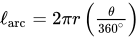
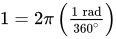
The relation 2π rad = 360° can be derived using the formula for arc length, , and by using a circle of radius 1. Since radian is the measure of an angle that subtends an arc of a length equal to the radius of the circle, . This can be further simplified to . Multiplying both sides by 360° gives 360° = 2π rad.

Unit symbol
The International Bureau of Weights and Measures[4] and International Organization for Standardization[6] specify rad as the symbol for the radian. Alternative symbols used 100 years ago are c (the superscript letter c, for "circular measure"), the letter r, or a superscript R,[7] but these variants are infrequently used, as they may be mistaken for a degree symbol (°) or a radius (r). Hence a value of 1.2 radians would most commonly be written as 1.2 rad; other notations include 1.2 r, 1.2rad, 1.2c, or 1.2R.
In mathematical writing, the symbol "rad" is often omitted. When quantifying an angle in the absence of any symbol, radians are assumed, and when degrees are meant, the degree sign ° is used.
Conversions

| Turns | Radians | Degrees | Gradians, or gons |
|---|---|---|---|
| 0 turn | 0 rad | 0° | 0g |
| 124 turn | π12 rad | 15° | 1623g |
| 116 turn | π8 rad | 22.5° | 25g |
| 112 turn | π6 rad | 30° | 3313g |
| 110 turn | π5 rad | 36° | 40g |
| 18 turn | π4 rad | 45° | 50g |
| 12π turn | 1 rad | c. 57.3° | c. 63.7g |
| 16 turn | π3 rad | 60° | 6623g |
| 15 turn | 2π5 rad | 72° | 80g |
| 14 turn | π2 rad | 90° | 100g |
| 13 turn | 2π3 rad | 120° | 13313g |
| 25 turn | 4π5 rad | 144° | 160g |
| 12 turn | π rad | 180° | 200g |
| 34 turn | 3π2 rad | 270° | 300g |
| 1 turn | 2π rad | 360° | 400g |
Conversion between radians and degrees
As stated, one radian is equal to . Thus, to convert from radians to degrees, multiply by .


For example:


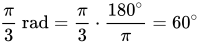
Conversely, to convert from degrees to radians, multiply by .


For example:


Radians can be converted to turns (complete revolutions) by dividing the number of radians by 2π.
Radian to degree conversion derivation
The length of circumference of a circle is given by , where is the radius of the circle.


So the following equivalent relation is true:
[Since a sweep is needed to draw a full circle]


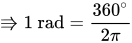
By the definition of radian, a full circle represents:


Combining both the above relations:

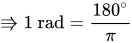
Conversion between radians and gradians
radians equals one turn, which is by definition 400 gradians (400 gons or 400g). So, to convert from radians to gradians multiply by , and to convert from gradians to radians multiply by . For example,




Advantages of measuring in radians

In calculus and most other branches of mathematics beyond practical geometry, angles are universally measured in radians. This is because radians have a mathematical "naturalness" that leads to a more elegant formulation of a number of important results.
Most notably, results in analysis involving trigonometric functions can be elegantly stated, when the functions' arguments are expressed in radians. For example, the use of radians leads to the simple limit formula
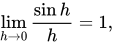
which is the basis of many other identities in mathematics, including
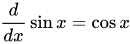
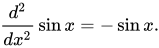
Because of these and other properties, the trigonometric functions appear in solutions to mathematical problems that are not obviously related to the functions' geometrical meanings (for example, the solutions to the differential equation , the evaluation of the integral and so on). In all such cases, it is found that the arguments to the functions are most naturally written in the form that corresponds, in geometrical contexts, to the radian measurement of angles.


The trigonometric functions also have simple and elegant series expansions when radians are used. For example, when x is in radians, the Taylor series for sin x becomes:

If x were expressed in degrees, then the series would contain messy factors involving powers of π/180: if x is the number of degrees, the number of radians is y = πx / 180, so

In a similar spirit, mathematically important relationships between the sine and cosine functions and the exponential function (see, for example, Euler's formula) can be elegantly stated, when the functions' arguments are in radians (and messy otherwise).


Comments
Post a Comment
Have something to say? Say it See it Feel it Live it then take It apart until you know what It is and As you were before you were born, feel the sound of it rattling around in the outbox smell the sight of it as the juices in your brain bag are fed little light waves of electric combinatory discombinatory salty sea solution sliding stealthily supplying the juice for the other end of the switch turned on by the turn on that turns on the on like one is when one is on and one is when one is idling on as the slumber soothes silky roads of well traversed travelers traipsing trails of tuned toned teeny tiny twirls of primes pumping nines into sixes and threes like humming honey bees evens evening out the odds as the unknown unknowns puddle sing a shiny bling and bring the ear funnel Z as close as eyeball close can see...z.z..z...