Pneumatics of Hero

Were one of course to go the distiller wave pressure might be an issue to keep a keen eye on as the booze was building the this and the that into the booze and the heat where the spinning warm jets do wonders for slicing slices of stone into stones smoother than a babys bottom and straighter than a round line tangentially touching the tips of tender finger tips tenderly... now all we need is a hammer and an anvil
Hephaestus (/hɪˈfiːstəs, hɪˈfɛstəs/; eight spellings; Greek: Ἥφαιστος, translit. Hḗphaistos) is the Greek god of blacksmiths, metalworking, carpenters, craftsmen, artisans, sculptors, metallurgy, fire (compare, however, with Hestia), and volcanoes.[2] Hephaestus's Roman counterpart is Vulcan. In Greek mythology, Hephaestus was either the son of Zeus and Hera or he was Hera's parthenogenous child. He was cast off Mount Olympus by his mother Hera because of his lameness, the result of a congenital impairment; or in another account, by Zeus for protecting Hera from his advances (in which case his lameness would have been the result of his fall rather than the reason for it).[3][4][5]
As a smithing god, Hephaestus made all the weapons of the gods in Olympus. He served as the blacksmith of the gods, and was worshipped in the manufacturing and industrial centres of Greece, particularly Athens. The cult of Hephaestus was based in Lemnos.[2] Hephaestus's symbols are a smith's hammer, anvil, and a pair of tongs.
Hephaestus and Aphrodite[edit]

Though married to Hephaestus, Aphrodite had an affair with Ares, the god of war. Eventually, Hephaestus discovered Aphrodite's affair through Helios, the all-seeing Sun, and planned a trap during one of their trysts. While Aphrodite and Ares lay together in bed, Hephaestus ensnared them in an unbreakable chain-link net so small as to be invisible and dragged them to Mount Olympus to shame them in front of the other gods for retribution.
The gods laughed at the sight of these naked lovers, and Poseidon persuaded Hephaestus to free them in return for a guarantee that Ares would pay the adulterer's fine or that he would pay it himself. Hephaestus states in The Odyssey that he would return Aphrodite to her father and demand back his bride price. The Emily Wilson translation depicts Hephaestus demanding/imploring Zeus before Poseidon offers, however, leading the reader to assume Zeus did not give back the "price" Hephaestus paid for "his daughter" and was thus why Poseidon intervened.[32] Some versions of the myth state that Zeus did not return the dowry, and in fact Aphrodite "simply charmed her way back again into her husband’s good graces."[33] In the Iliad, Hephaestus is presented as divorced from Aphrodite, and now married to the Grace Aglaea.[34] In the Theogony, Aglaea is presented as Hephaestus' mate with no apparent mention of any marriage to Aphrodite.[35]
In a much later interpolated detail, Ares put the young soldier Alectryon, by their door to warn them of Helios's arrival as he suspected that Helios would tell Hephaestus of Aphrodite's infidelity if the two were discovered, but Alectryon fell asleep on guard duty.[36] Helios discovered the two and alerted Hephaestus, as Ares in rage turned Alectryon into a rooster, which always crows at dawn when the sun is about to rise announcing its arrival.[37]
The Thebans told that the union of Ares and Aphrodite produced Harmonia. However, of the union of Hephaestus with Aphrodite, there was no issue unless Virgil was serious when he said that Eros was their child.[38] Later authors explain this statement by saying that Eros was sired by Ares but passed off to Hephaestus as his own son.[citation needed] Because Harmonia was conceived during Aphrodite's marriage to Hephaestus, for revenge, on Harmonia's wedding day to Cadmus Hephaestus gifted her with a finely worked but cursed necklace that brought immense suffering to her descendants, culminating with the story of Oedipus.[39]
Hephaestus was somehow connected with the archaic, pre-Greek Phrygian and Thracian mystery cult of the Kabeiroi, who were also called the Hephaistoi, "the Hephaestus-men", in Lemnos. One of the three Lemnian tribes also called themselves Hephaestion and claimed direct descent from the god.
Hephaestus and Athena[edit]
Hephaestus is to the male gods as Athena is to the females, for he gives skill to mortal artists and was believed to have taught men the arts alongside Athena.[40] At Athens they had temples and festivals in common.[d] Both were believed to have great healing powers, and Lemnian earth (terra Lemnia) from the spot on which Hephaestus had fallen was believed to cure madness, the bites of snakes, and haemorrhage, and priests of Hephaestus knew how to cure wounds inflicted by snakes.[41]
He was represented in the temple of Athena Chalcioecus (Athena of the Bronze House[42]) at Sparta, in the act of delivering his mother;[43] on the chest of Cypselus, giving Achilles's armour to Thetis;[44] and at Athens there was the famous statue of Hephaestus by Alcamenes, in which his physical disability was only subtly portrayed.[45] He had almost "no cults except in Athens" and was possibly seen as a more approachable god to the city which shared her namesake.[46] The Greeks frequently placed miniature statues of Hephaestus near their hearths, and these figures are the oldest of all his representations.[47] During the best period of Grecian art he was represented as a vigorous man with a beard, and is characterized by his hammer or some other crafting tool, his oval cap, and the chiton.
Athena is sometimes thought to be the "soulmate" of Hephaestus.[48] Nonetheless, he "seeks impetuously and passionately to make love to Athena: at the moment of climax she pushes him aside, and his semen falls to the earth where it impregnates Gaia."[49]
Mimas (Giant)
In Greek mythology, Mimas (Ancient Greek: Μίμας) was one of the Gigantes (Giants), the offspring of Gaia, born from the blood of the castrated Uranus.[1]
Mythology[edit]
According to the mythographer Apollodorus, he was killed during the Gigantomachy, the cosmic battle of the Giants with the Twelve Olympians, by Hephaestus with "missiles of red-hot metal" from his forge.[2] In Euripides' Ion (c. 410 BC), the chorus, describing the wonders of the late sixth century Temple of Apollo at Delphi, tell of seeing depicted there the Gigantomachy showing, among other things, Zeus burning Mimas "to ashes" with his thunderbolt.[3] In the Argonautica by Apollonius of Rhodes, and the Gigantomachia by Claudian, Mimas was killed by Ares (or in Claudian's case by Ares' Roman counterpart Mars).[4] Mimas is also mentioned in the company of other Giants, by the Latin writers Horace[5] and Seneca.[6]
A fragment of an Attic black-figure dinos by Lydos (Athens Akropolis 607) dating from the second quarter of the sixth century, which depicted the Gigantomachy, shows Aphrodite with shield and spear battling a Giant also with shield (displaying a large bee) and spear, whose name is inscribed (retrograde) as "Mimos", possibly in error for "Mimas".[7]
He was said to be buried under Prochyte, one of the Phlegraean Islands off the coast of Naples.[8] Claudian mentions Mimas as one of several vanquished Giants whose weapons, as spoils of war, hung on trees in a wood near the summit of Mount Etna.[9]
Mimas is possibly the same as the Giant named Mimon on the Gigantomachy depicted on the north frieze of the Siphnian Treasury at Delphi (c. 525 BC),[10] and a late fifth century BC cup from Vulci (Berlin F2531) shown fighting Ares.[11]
Namesake[edit]
In 1847, the mythological Giant inspired the name of the moon closest to Saturn.
See also[edit]
- Alcyoneus
- Picolous
- Polybotes
Uranus (mythology)
Uranus Member of the Primordial Gods 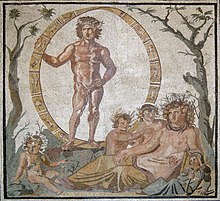
Personal information Parents Gaia Consort Gaia Children The Titans, the Cyclopes, the Hecatoncheires, the Erinyes (Furies), the Giants, the Meliae, and Aphrodite[1] Equivalents Roman equivalent Caelus Mesopotamian equivalent Anu[2] Part of a series on Ancient Greek religion 
In Greek mythology, Uranus (/ˈjʊərənəs, jʊˈreɪnəs/ (
 listen) YOOR-ə-nəs, yoo-RAY-nəs),[3] sometimes written Ouranos (Ancient Greek: Οὐρανός, lit. 'sky', [uːranós]), is the personification of the sky and one of the Greek primordial deities. According to Hesiod, Uranus was the son and husband of Gaia (Earth), with whom he fathered the first generation of Titans. However, no cult addressed directly to Uranus survived into Classical times,[4] and Uranus does not appear among the usual themes of Greek painted pottery. Elemental Earth, Sky, and Styx might be joined, however, in solemn invocation in Homeric epic.[5] Uranus is associated with the Roman god Caelus.[6][7][8]
Etymology[edit]
Most linguists trace the etymology of the name Οὐρανός to a Proto-Greek form *Worsanós (Ϝορσανός),[9] enlarged from *ṷorsó- (also found in Greek οὐρέω (ouréō) 'to urinate', Sanskrit varṣá 'rain', Hittite ṷarša- 'fog, mist').[10] The basic Indo-European root is *ṷérs- 'to rain, moisten' (also found in Greek eérsē 'dew', Sanskrit várṣati 'to rain', or Avestan aiβi.varəšta 'it rained on'), making Ouranos the "rain-maker",[10] or the "lord of rain".[11]
A less likely etymology is a derivative meaning 'the one standing on high' from PIE *ṷérso- (cf. Sanskrit várṣman 'height, top', Lithuanian viršùs 'upper, highest seat', Russian verx 'height, top'). Of some importance in the comparative study of Indo-European mythology is the identification by Georges Dumézil (1934)[12] of Uranus with the Vedic deity Váruṇa (Mitanni Aruna), god of the sky and waters, but the etymological equation is now considered untenable.[13]
Genealogy[edit]
In Hesiod's Theogony, which came to be accepted by the Greeks as the "standard" account,[14] from Gaia (Earth), the first entity to come into existence after Chaos (Void), came Uranus, the Ourea (Mountains), and Pontus (Sea).[15]
Then, according to the Theogony, Uranus mated with Gaia, and she gave birth to the twelve Titans: Oceanus, Coeus, Crius, Hyperion, Iapetus, Theia, Rhea, Themis, Mnemosyne, Phoebe, Tethys and Cronus; the Cyclopes: Brontes, Steropes and Arges; and the Hecatoncheires ("Hundred-Handed Ones"): Cottus, Briareus, and Gyges.[16]
showDescendants of Gaia (Earth) and Uranus (Sky), according to Hesiod[17] Further, according to the Theogony, when Cronus castrated Uranus, from Uranus' blood, which splattered onto the earth, came the Erinyes (Furies), the Giants, and the Meliae. Also, according to the Theogony, Cronus threw the severed genitals into the sea, around which "a white foam spread" and "grew" into the goddess Aphrodite,[18] although according to Homer, Aphrodite was the daughter of Zeus and Dione.[19]
showDescendants of Gaia and Uranus' blood, and Uranus' genitals, according to Hesiod[20] Greek deities
seriesPrimordial deities Chthonic deities Other accounts[edit]
Other sources give other genealogies. In the lost epic poem the Titanomachy, Uranus was apparently the son of Aether,[21] while according to others Uranus was the son of one "Acmon".[22] According to Orphic texts, Uranus (along with Gaia) was the offspring of Nyx (Night) and Phanes.[23]
The poet Sappho (c. 630 – c. 570 BC), was said to have made Uranus the father of Eros, by either Gaia, according one source, or Aphrodite, according to another.[24]
The mythographer Apollodorus, gives a slightly different genealogy from Hesiod's. Without mentioning any ancestors, he begins his account by saying simply that Uranus "was the first who ruled over the whole world."[25] According to Apollodorus, the Titans (instead of being Uranus' firstborn as in Hesiod) were born after the three Hundred-Handers and the three Cyclopes,[26] and there were thirteen original Titans, adding the Titanide Dione to Hesiod's list.[27]
Passages in a section of the Iliad called the Deception of Zeus suggest the possibility that Homer knew a tradition in which Oceanus and Tethys (rather than Uranus and Gaia, as in Hesiod) were the parents of the Titans.[28] Plato, in his Timaeus, provides a genealogy (probably Orphic) which perhaps reflected an attempt to reconcile this apparent divergence between Homer and Hesiod, with Uranus and Gaia as the parents of Oceanus and Tethys, and Oceanus and Tethys as the parents of Cronus and Rhea and the other Titans.[29]
In Roman mythology, Uranus' counterpart was Caelus (Sky). Cicero says Caelus was the offspring of Aether and Dies (Day),[30] and that Caelus and Dies were the parents of Mercury (Hermes).[31] While, Hyginus says that, in addition to Caelus, Aether and Dies were also the parents of Terra (Earth), and Mare (Sea).[32]
Castration and overthrow[edit]
As Hesiod tells the story, Gaia "first bore starry Heaven [Uranus], equal to herself, to cover her on every side, and to be an ever-sure abiding-place for the blessed gods."[33] Then, with Gaia, Uranus produced eighteen children: the twelve Titans, the three Cyclopes, and the three Hecatoncheires (Hundred-Handers),[34] but hating them,[35] he hid them away somewhere inside Gaia.[36] Angry and in distress, Gaia fashioned a sickle made of adamant and urged her children to punish their father. Only her son Cronus, the youngest Titan, was willing to do so.[37] So Gaia hid Cronus in "ambush" gave him the adamantine sickle, and when Uranus came to lie with Gaia, Cronus reached out and castrated his father, casting the severed testicles into the sea.[38] Uranus' castration allowed the Titans to rule and Cronus to assume supreme command of the cosmos.[39]
For this "fearful deed", Uranus called his sons "Titans (Strainers) in reproach" and said that "vengeance for it would come afterwards."[40] According to Hesiod, from the blood that spilled from Uranus onto the Earth came forth the Giants, the Erinyes (the avenging Furies), the Meliae (the ash-tree nymphs). From the genitals in the sea came forth Aphrodite.[41] According to some accounts, the mythical Phaeacians, visited by Odysseus in the Odyssey, were also said to have sprung from the blood of Uranus' castration.[42]
Various sites have been associated with Cronus' sickle, and Uranus' castration.[43] Two of these were on the island of Sicily. According to the Alexandrian poet Callimachus (c. 270 BC), Cronus' sickle was buried at Zancle in Sicily, saying that it was "hidden in a hollow under the ground" there.[44] The other Sicilian site is Drepanum (modern Trapani), whose name is derived from the Greek word for "sickle". Another Alexandrian poet, Lycophron (c. 270 BC), mentions "rounding the Cronos' Sickle's leap", an apparent reference to the "leap" of the sickle being thrown into the sea at Drepanum.[45]
However other sites were also associated with the sickle. The geographer Pausanias, reports that the sickle was said to have been thrown into the sea from the cape near Bolina, not far from Argyra on the coast of Achaea, and says that "For this reason they call the cape Drepanum".[46] The historian Timaeus located the sickle at Corcyra, which the islanders claimed to be Phaeacia the island home of the Phaeacians, who (as noted above) were said to have been born from the blood of Uranus' castration.[47]
After his castration, Uranus recedes into the background. Apart from he and Gaia (now reconciled?)[48] warning their son Cronus that he is destined to be overthrown by once of his children, advising their daughter Rhea, Cronus' wife, to go to Lyctus on Crete to give birth to Zeus, so that Zeus would be saved from Cronus, and advising Zeus to swallow his first wife Metis, so that Zeus would not in turn be overthrown by his son, Uranus plays no further role in Greek mythology.[49]
The sky (ouranos)[edit]
 This section needs additional citations for verification. (November 2016)
After his castration, the Sky came no more to cover the Earth at night, but held to its place, and, according to Carl Kerényi, "the original begetting came to an end".[50] Uranus was scarcely regarded as anthropomorphic, aside from the genitalia in the castration myth. He was simply the sky, which was conceived by the ancients as an overarching dome or roof of bronze, held in place (or turned on an axis) by the Titan Atlas. In formulaic expressions in the Homeric poems ouranos is sometimes an alternative to Olympus as the collective home of the gods; an obvious occurrence would be the moment in Iliad 1.495, when Thetis rises from the sea to plead with Zeus: "and early in the morning she rose up to greet Ouranos-and-Olympus and she found the son of Kronos ..."
William Sale remarks that "... 'Olympus' is almost always used [as the home of the Olympian gods], but ouranos often refers to the natural sky above us without any suggestion that the gods, collectively live there".[51] Sale concluded that the earlier seat of the gods was the actual Mount Olympus, from which the epic tradition by the time of Homer had transported them to the sky, ouranos. By the sixth century, when a "heavenly Aphrodite" (Aphrodite Urania) was to be distinguished from the "common Aphrodite of the people", ouranos signifies purely the celestial sphere itself.
Children[edit]
Gaia is the personification of the Earth, and these are her offspring as related in various myths. Some are related consistently, some are mentioned only in minor variants of myths, and others are related in variants that are considered to reflect a confusion of the subject or association.
Offspring and fathers (Hesiod) Offspring Father Uranus,[61] Pontus,[62] The Ourea[63] No father The Titans (Oceanus, Coeus, Crius, Iapetus, Hyperion, Theia, Themis, Tethys, Phoebe, Mnemosyne, Rhea, and Cronus) The Cyclopes (Arges, Brontes, and Steropes)
The Hecatonchires (Briareus, Cottus, and Gyes)
Uranus Nereus, Thaumas, Phorcys, Ceto, Eurybia Pontus[64] Typhon[65] Tartarus Offspring and fathers (Other sources) Offspring Father The Autochthons: Cecrops, Palaechthon, Pelasgus, Alalcomeneus, Dysaules, Cabeirus, Phlyus (father of Celaenus), and Leitus.[66] No father The Curetes[i][ii] The Elder Muses: Mneme, Melete, and Aoide
The Telchines: Actaeus, Megalesius, Ormenus, and Lycus
Aristaeus[68]
Uranus Echidna[iii] Giants: Enceladus, Coeus, Astraeus, Pelorus, Pallas, Emphytus, Rhoecus, Agrius, Ephialtes, Eurytus, Themoises, Theodamas, Otus, Polyboetes, and Iapetus.
Tartarus The Telchines Pontus Uranus[iv] - Personifications:
- Altercation (Amphillogia) (sometimes)
- Combat (Hysminai) (sometimes)
- Deceit (Dolos) (sometimes)
- Falsehood (sometimes)
- Forgetfulness (Lethe) (sometimes)
- Grief (Algos) (sometimes)
- Incest (Incestum)[v]
- Intemperance (Intemprentia)[v]
- Lamentation (Penthus)
- Oath (Horkos) (sometimes)
- Pride (Superbia)[v]
- Sloth (Aergia)
- Vengeance (Poine)
- Wrath (Lyssa) (sometimes)
Aether Antaeus,[70] Charybdis,[71] Laistrygon Poseidon Achelous,[72][73] Bisaltes[74] Helios Agdistis, Manes,[75] Cyprian Centaurs Zeus Triptolemos[76] Oceanus Erichthonius of Athens[77] Hephaestus Unknown - Personifications:


Comments
Post a Comment
Have something to say? Say it See it Feel it Live it then take It apart until you know what It is and As you were before you were born, feel the sound of it rattling around in the outbox smell the sight of it as the juices in your brain bag are fed little light waves of electric combinatory discombinatory salty sea solution sliding stealthily supplying the juice for the other end of the switch turned on by the turn on that turns on the on like one is when one is on and one is when one is idling on as the slumber soothes silky roads of well traversed travelers traipsing trails of tuned toned teeny tiny twirls of primes pumping nines into sixes and threes like humming honey bees evens evening out the odds as the unknown unknowns puddle sing a shiny bling and bring the ear funnel Z as close as eyeball close can see...z.z..z...