Apsis The Action Principle
Brans–Dicke theory
In theoretical physics, the Brans–Dicke theory of gravitation (sometimes called the Jordan–Brans–Dicke theory) is a theoretical framework to explain gravitation. It is a competitor to Einstein's theory of general relativity. It is an example of a scalar–tensor theory, a gravitational theory in which the gravitational interaction is mediated by a scalar field as well as the tensor field of general relativity. The gravitational constant G is not presumed to be constant but instead 1/G is replaced by a scalar field which can vary from place to place and with time.

The theory was developed in 1961 by Robert H. Dicke and Carl H. Brans[1] building upon, among others, the earlier 1959 work of Pascual Jordan. At present, both Brans–Dicke theory and general relativity are generally held to be in agreement with observation. Brans–Dicke theory represents a minority viewpoint in physics.
Comparison with general relativity[edit]
Both Brans–Dicke theory and general relativity are examples of a class of relativistic classical field theories of gravitation, called metric theories. In these theories, spacetime is equipped with a metric tensor, , and the gravitational field is represented (in whole or in part) by the Riemann curvature tensor , which is determined by the metric tensor.


All metric theories satisfy the Einstein equivalence principle, which in modern geometric language states that in a very small region (too small to exhibit measurable curvature effects), all the laws of physics known in special relativity are valid in local Lorentz frames. This implies in turn that metric theories all exhibit the gravitational redshift effect.
As in general relativity, the source of the gravitational field is considered to be the stress–energy tensor or matter tensor. However, the way in which the immediate presence of mass-energy in some region affects the gravitational field in that region differs from general relativity. So does the way in which spacetime curvature affects the motion of matter. In the Brans–Dicke theory, in addition to the metric, which is a rank two tensor field, there is a scalar field, , which has the physical effect of changing the effective gravitational constant from place to place. (This feature was actually a key desideratum of Dicke and Brans; see the paper by Brans cited below, which sketches the origins of the theory.)
The field equations of Brans–Dicke theory contain a parameter, , called the Brans–Dicke coupling constant. This is a true dimensionless constant which must be chosen once and for all. However, it can be chosen to fit observations. Such parameters are often called tunable parameters. In addition, the present ambient value of the effective gravitational constant must be chosen as a boundary condition. General relativity contains no dimensionless parameters whatsoever, and therefore is easier to falsify (show whether false) than Brans–Dicke theory. Theories with tunable parameters are sometimes deprecated on the principle that, of two theories which both agree with observation, the more parsimonious is preferable. On the other hand, it seems as though they are a necessary feature of some theories, such as the weak mixing angle of the Standard Model.

Brans–Dicke theory is "less stringent" than general relativity in another sense: it admits more solutions. In particular, exact vacuum solutions to the Einstein field equation of general relativity, augmented by the trivial scalar field , become exact vacuum solutions in Brans–Dicke theory, but some spacetimes which are not vacuum solutions to the Einstein field equation become, with the appropriate choice of scalar field, vacuum solutions of Brans–Dicke theory. Similarly, an important class of spacetimes, the pp-wave metrics, are also exact null dust solutions of both general relativity and Brans–Dicke theory, but here too, Brans–Dicke theory allows additional wave solutions having geometries which are incompatible with general relativity.

Like general relativity, Brans–Dicke theory predicts light deflection and the precession of perihelia of planets orbiting the Sun. However, the precise formulas which govern these effects, according to Brans–Dicke theory, depend upon the value of the coupling constant . This means that it is possible to set an observational lower bound on the possible value of from observations of the solar system and other gravitational systems. The value of consistent with experiment has risen with time. In 1973 was consistent with known data. By 1981 was consistent with known data. In 2003 evidence – derived from the Cassini–Huygens experiment – shows that the value of must exceed 40,000.


It is also often taught[2] that general relativity is obtained from the Brans–Dicke theory in the limit . But Faraoni[3] claims that this breaks down when the trace of the stress-energy momentum vanishes, i.e. . An example of which is the Campanelli-Lousto wormhole solution.[4] Some have argued[who?] that only general relativity satisfies the strong equivalence principle.


The field equations[edit]
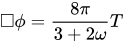
The field equations of the Brans–Dicke theory are
- ,

where
- is the dimensionless Dicke coupling constant;
- is the metric tensor;
- is the Einstein tensor, a kind of average curvature;
- is the Ricci tensor, a kind of trace of the curvature tensor;
- is the Ricci scalar, the trace of the Ricci tensor;
- is the stress–energy tensor;
- is the trace of the stress–energy tensor;
- is the scalar field; and
- is the Laplace–Beltrami operator or covariant wave operator, .




The first equation says that the trace of the stress–energy tensor acts as the source for the scalar field . Since electromagnetic fields contribute only a traceless term to the stress–energy tensor, this implies that in a region of spacetime containing only an electromagnetic field (plus the gravitational field), the right hand side vanishes, and obeys the (curved spacetime) wave equation. Therefore, changes in propagate through electrovacuum regions; in this sense, we say that is a long-range field.
The second equation describes how the stress–energy tensor and scalar field together affect spacetime curvature. The left hand side, the Einstein tensor, can be thought of as a kind of average curvature. It is a matter of pure mathematics that, in any metric theory, the Riemann tensor can always be written as the sum of the Weyl curvature (or conformal curvature tensor) plus a piece constructed from the Einstein tensor.
For comparison, the field equation of general relativity is simply

This means that in general relativity, the Einstein curvature at some event is entirely determined by the stress–energy tensor at that event; the other piece, the Weyl curvature, is the part of the gravitational field which can propagate as a gravitational wave across a vacuum region. But in the Brans–Dicke theory, the Einstein tensor is determined partly by the immediate presence of mass-energy and momentum, and partly by the long-range scalar field .

The vacuum field equations of both theories are obtained when the stress–energy tensor vanishes. This models situations in which no non-gravitational fields are present.
The action principle[edit]
The following Lagrangian contains the complete description of the Brans–Dicke theory:

where is the determinant of the metric, is the four-dimensional volume form, and is the matter term or matter Lagrangian density.


The matter term includes the contribution of ordinary matter (e.g. gaseous matter) and also electromagnetic fields. In a vacuum region, the matter term vanishes identically; the remaining term is the gravitational term. To obtain the vacuum field equations, we must vary the gravitational term in the Lagrangian with respect to the metric ; this gives the second field equation above. When we vary with respect to the scalar field , we obtain the first field equation.
Note that, unlike for the General Relativity field equations, the term does not vanish, as the result is not a total derivative. It can be shown that


To prove this result, use

By evaluating the s in Riemann normal coordinates, 6 individual terms vanish. 6 further terms combine when manipulated using Stokes' theorem to provide the desired .


For comparison, the Lagrangian defining general relativity is

Varying the gravitational term with respect to gives the vacuum Einstein field equation.
In both theories, the full field equations can be obtained by variations of the full Lagrangian.
Apsis
 | This article needs additional citations for verification. (December 2020) |
.png)

| Part of a series on |
| Astrodynamics |
|---|
 |
An apsis (from Ancient Greek ἁψίς (hapsís) 'arch, vault'; pl. apsides /ˈæpsɪˌdiːz/ AP-sih-deez)[1][2] is the farthest or nearest point in the orbit of a planetary body about its primary body. The apsides of Earth's orbit of the Sun are two: the aphelion, where Earth is farthest from the sun, and the perihelion, where it is nearest. "Apsides" can also refer to the distance of the extreme range of an object orbiting a host body.
General description[edit]
There are two apsides in any elliptic orbit. Each is named by selecting the appropriate prefix: ap-, apo- (from ἀπ(ό), (ap(o)-) 'away from'), or peri- (from περί (peri-) 'near')—then joining it to the reference suffix of the "host" body being orbited. (For example, the reference suffix for Earth is -gee, hence apogee and perigee are the names of the apsides for the Moon, and any other artificial satellites of the Earth. The suffix for the Sun is -helion, hence aphelion and perihelion are the names of the apsides for the Earth and for the Sun's other planets, comets, asteroids, etc., (see table, top figure).)
According to Newton's laws of motion all periodic orbits are ellipses, including: 1) the single orbital ellipse, where the primary body is fixed at one focus point and the planetary body orbits around that focus (see top figure); and 2) the two-body system of interacting elliptic orbits: both bodies orbit their joint center of mass (or barycenter), which is located at a focus point that is common to both ellipses, (see second figure). For such a two-body system, when one mass is sufficiently larger than the other, the smaller ellipse (of the larger body) around the barycenter comprises one of the orbital elements of the larger ellipse (of the smaller body).
The barycenter of the two bodies may lie well within the bigger body—e.g., the Earth–Moon barycenter is about 75% of the way from Earth's center to its surface. If, compared to the larger mass, the smaller mass is negligible (e.g., for satellites), then the orbital parameters are independent of the smaller mass.
When used as a suffix—that is, -apsis—the term can refer to the two distances from the primary body to the orbiting body when the latter is located: 1) at the periapsis point, or 2) at the apoapsis point (compare both graphics, second figure). The line of apsides denotes the distance of the line that joins the nearest and farthest points across an orbit; it also refers simply to the extreme range of an object orbiting a host body (see top figure; see third figure).
In orbital mechanics, the apsides technically refer to the distance measured between the barycenters of the central body and orbiting body. However, in the case of a spacecraft, the terms are commonly used to refer to the orbital altitude of the spacecraft above the surface of the central body (assuming a constant, standard reference radius).
Terminology[edit]
The words "pericenter" and "apocenter" are often seen, although periapsis/apoapsis are preferred in technical usage.
- For generic situations where the primary is not specified, the terms pericenter and apocenter are used for naming the extreme points of orbits (see table, top figure); periapsis and apoapsis (or apapsis) are equivalent alternatives, but these terms also frequently refer to distances—that is, the smallest and largest distances between the orbiter and its host body (see second figure).
- For a body orbiting the Sun, the point of least distance is the perihelion (/ˌpɛrɪˈhiːliən/), and the point of greatest distance is the aphelion (/æpˈhiːliən/);[3] when discussing orbits around other stars the terms become periastron and apastron.
- When discussing a satellite of Earth, including the Moon, the point of least distance is the perigee (/ˈpɛrɪdʒiː/), and of greatest distance, the apogee (from Ancient Greek: Γῆ (Gē), "land" or "earth").[4]
- For objects in lunar orbit, the point of least distance are called the pericynthion (/ˌpɛrɪˈsɪnθiən/) and the greatest distance the apocynthion (/ˌæpəˈsɪnθiən/). The terms perilune and apolune, as well as periselene and apselene are also used.[5] Since the Moon has no natural satellites this only applies to man-made objects.
Etymology[edit]
The words perihelion and aphelion were coined by Johannes Kepler[6] to describe the orbital motions of the planets around the Sun. The words are formed from the prefixes peri- (Greek: περί, near) and apo- (Greek: ἀπό, away from), affixed to the Greek word for the sun, (ἥλιος, or hēlíou).[3]
Various related terms are used for other celestial objects. The suffixes -gee, -helion, -astron and -galacticon are frequently used in the astronomical literature when referring to the Earth, Sun, stars, and the galactic center respectively. The suffix -jove is occasionally used for Jupiter, but -saturnium has very rarely been used in the last 50 years for Saturn. The -gee form is also used as a generic closest-approach-to "any planet" term—instead of applying it only to Earth.
During the Apollo program, the terms pericynthion and apocynthion were used when referring to orbiting the Moon; they reference Cynthia, an alternative name for the Greek Moon goddess Artemis.[7] Regarding black holes, the terms perimelasma and apomelasma (from a Greek root) were used by physicist and science-fiction author Geoffrey A. Landis in a story published in 1998,[8] thus appearing before perinigricon and aponigricon (from Latin) in the scientific literature in 2002,[9] and before peribothron (from Greek bothros, meaning "hole" or "pit") in 2015.[10]
Terminology summary[edit]
The suffixes shown below may be added to prefixes peri- or apo- to form unique names of apsides for the orbiting bodies of the indicated host/(primary) system. However, only for the Earth and Sun systems are the unique suffixes commonly used. Exoplanet studies commonly use -astron, but typically, for other host systems the generic suffix, -apsis, is used instead.[11][failed verification]
| Astronomical host object | Sun | Mercury | Venus | Earth | Moon | Mars | Ceres | Jupiter | Saturn |
|---|---|---|---|---|---|---|---|---|---|
| Suffix | -helion | -hermion | -cythe | -gee | -lune[5] -cynthion -selene[5] | -areion | -demeter[12] | -jove | -chron[5] -kronos -saturnium -krone[13] |
| Origin of the name | Helios | Hermes | Cytherean | Gaia | Luna Cynthia Selene | Ares | Demeter | Zeus Jupiter | Cronos Saturn |
| Astronomical host object | Star | Galaxy | Barycenter | Black hole |
|---|---|---|---|---|
| Suffix | -astron | -galacticon | -center -focus -apsis | -melasma -bothron -nigricon |
| Origin of the name | Lat: astra; stars | Gr: galaxias; galaxy | Gr: melos; black Gr: bothros; hole Lat: niger; black |
Perihelion and aphelion[edit]

The perihelion (q) and aphelion (Q) are the nearest and farthest points respectively of a body's direct orbit around the Sun.
Comparing osculating elements at a specific epoch to effectively those at a different epoch will generate differences. The time-of-perihelion-passage as one of six osculating elements is not an exact prediction (other than for a generic 2-body model) of the actual minimum distance to the Sun using the full dynamical model. Precise predictions of perihelion passage require numerical integration.
Inner planets and outer planets[edit]
The two images below show the orbits, orbital nodes, and positions of perihelion (q) and aphelion (Q) for the planets of the Solar System[14] as seen from above the northern pole of Earth's ecliptic plane, which is coplanar with Earth's orbital plane. The planets travel counterclockwise around the Sun and for each planet, the blue part of their orbit travels north of the ecliptic plane, the pink part travels south, and dots mark perihelion (green) and aphelion (orange).
The first image (below-left) features the inner planets, situated outward from the Sun as Mercury, Venus, Earth, and Mars. The reference Earth-orbit is colored yellow and represents the orbital plane of reference. At the time of vernal equinox, the Earth is at the bottom of the figure. The second image (below-right) shows the outer planets, being Jupiter, Saturn, Uranus, and Neptune.
The orbital nodes are the two end points of the "line of nodes" where a planet's tilted orbit intersects the plane of reference;[15] here they may be 'seen' as the points where the blue section of an orbit meets the pink.


Lines of apsides[edit]
The chart shows the extreme range—from the closest approach (perihelion) to farthest point (aphelion)—of several orbiting celestial bodies of the Solar System: the planets, the known dwarf planets, including Ceres, and Halley's Comet. The length of the horizontal bars correspond to the extreme range of the orbit of the indicated body around the Sun. These extreme distances (between perihelion and aphelion) are the lines of apsides of the orbits of various objects around a host body.

Earth perihelion and aphelion[edit]
Currently, the Earth reaches perihelion in early January, approximately 14 days after the December solstice. At perihelion, the Earth's center is about 0.98329 astronomical units (AU) or 147,098,070 km (91,402,500 mi) from the Sun's center. In contrast, the Earth reaches aphelion currently in early July, approximately 14 days after the June solstice. The aphelion distance between the Earth's and Sun's centers is currently about 1.01671 AU or 152,097,700 km (94,509,100 mi).
The dates of perihelion and aphelion change over time due to precession and other orbital factors, which follow cyclical patterns known as Milankovitch cycles. In the short term, such dates can vary up to 2 days from one year to another.[16] This significant variation is due to the presence of the Moon: while the Earth–Moon barycenter is moving on a stable orbit around the Sun, the position of the Earth's center which is on average about 4,700 kilometres (2,900 mi) from the barycenter, could be shifted in any direction from it—and this affects the timing of the actual closest approach between the Sun's and the Earth's centers (which in turn defines the timing of perihelion in a given year).[17]
Because of the increased distance at aphelion, only 93.55% of the radiation from the Sun falls on a given area of Earth's surface as does at perihelion, but this does not account for the seasons, which result instead from the tilt of Earth's axis of 23.4° away from perpendicular to the plane of Earth's orbit.[18] Indeed, at both perihelion and aphelion it is summer in one hemisphere while it is winter in the other one. Winter falls on the hemisphere where sunlight strikes least directly, and summer falls where sunlight strikes most directly, regardless of the Earth's distance from the Sun.
In the northern hemisphere, summer occurs at the same time as aphelion, when solar radiation is lowest. Despite this, summers in the northern hemisphere are on average 2.3 °C (4 °F) warmer than in the southern hemisphere, because the northern hemisphere contains larger land masses, which are easier to heat than the seas.[19]
Perihelion and aphelion do however have an indirect effect on the seasons: because Earth's orbital speed is minimum at aphelion and maximum at perihelion, the planet takes longer to orbit from June solstice to September equinox than it does from December solstice to March equinox. Therefore, summer in the northern hemisphere lasts slightly longer (93 days) than summer in the southern hemisphere (89 days).[20]
Astronomers commonly express the timing of perihelion relative to the First Point of Aries not in terms of days and hours, but rather as an angle of orbital displacement, the so-called longitude of the periapsis (also called longitude of the pericenter). For the orbit of the Earth, this is called the longitude of perihelion, and in 2000 it was about 282.895°; by 2010, this had advanced by a small fraction of a degree to about 283.067°.[21]
For the orbit of the Earth around the Sun, the time of apsis is often expressed in terms of a time relative to seasons, since this determines the contribution of the elliptical orbit to seasonal variations. The variation of the seasons is primarily controlled by the annual cycle of the elevation angle of the Sun, which is a result of the tilt of the axis of the Earth measured from the plane of the ecliptic. The Earth's eccentricity and other orbital elements are not constant, but vary slowly due to the perturbing effects of the planets and other objects in the solar system (Milankovitch cycles).
On a very long time scale, the dates of the perihelion and of the aphelion progress through the seasons, and they make one complete cycle in 22,000 to 26,000 years. There is a corresponding movement of the position of the stars as seen from Earth, called the apsidal precession. (This is closely related to the precession of the axes.) The dates and times of the perihelions and aphelions for several past and future years are listed in the following table:[22]
Earth perihelion and aphelion[edit]
Currently, the Earth reaches perihelion in early January, approximately 14 days after the December solstice. At perihelion, the Earth's center is about 0.98329 astronomical units (AU) or 147,098,070 km (91,402,500 mi) from the Sun's center. In contrast, the Earth reaches aphelion currently in early July, approximately 14 days after the June solstice. The aphelion distance between the Earth's and Sun's centers is currently about 1.01671 AU or 152,097,700 km (94,509,100 mi).
The dates of perihelion and aphelion change over time due to precession and other orbital factors, which follow cyclical patterns known as Milankovitch cycles. In the short term, such dates can vary up to 2 days from one year to another.[16] This significant variation is due to the presence of the Moon: while the Earth–Moon barycenter is moving on a stable orbit around the Sun, the position of the Earth's center which is on average about 4,700 kilometres (2,900 mi) from the barycenter, could be shifted in any direction from it—and this affects the timing of the actual closest approach between the Sun's and the Earth's centers (which in turn defines the timing of perihelion in a given year).[17]
Because of the increased distance at aphelion, only 93.55% of the radiation from the Sun falls on a given area of Earth's surface as does at perihelion, but this does not account for the seasons, which result instead from the tilt of Earth's axis of 23.4° away from perpendicular to the plane of Earth's orbit.[18] Indeed, at both perihelion and aphelion it is summer in one hemisphere while it is winter in the other one. Winter falls on the hemisphere where sunlight strikes least directly, and summer falls where sunlight strikes most directly, regardless of the Earth's distance from the Sun.
In the northern hemisphere, summer occurs at the same time as aphelion, when solar radiation is lowest. Despite this, summers in the northern hemisphere are on average 2.3 °C (4 °F) warmer than in the southern hemisphere, because the northern hemisphere contains larger land masses, which are easier to heat than the seas.[19]
Perihelion and aphelion do however have an indirect effect on the seasons: because Earth's orbital speed is minimum at aphelion and maximum at perihelion, the planet takes longer to orbit from June solstice to September equinox than it does from December solstice to March equinox. Therefore, summer in the northern hemisphere lasts slightly longer (93 days) than summer in the southern hemisphere (89 days).[20]
Astronomers commonly express the timing of perihelion relative to the First Point of Aries not in terms of days and hours, but rather as an angle of orbital displacement, the so-called longitude of the periapsis (also called longitude of the pericenter). For the orbit of the Earth, this is called the longitude of perihelion, and in 2000 it was about 282.895°; by 2010, this had advanced by a small fraction of a degree to about 283.067°.[21]
For the orbit of the Earth around the Sun, the time of apsis is often expressed in terms of a time relative to seasons, since this determines the contribution of the elliptical orbit to seasonal variations. The variation of the seasons is primarily controlled by the annual cycle of the elevation angle of the Sun, which is a result of the tilt of the axis of the Earth measured from the plane of the ecliptic. The Earth's eccentricity and other orbital elements are not constant, but vary slowly due to the perturbing effects of the planets and other objects in the solar system (Milankovitch cycles).
On a very long time scale, the dates of the perihelion and of the aphelion progress through the seasons, and they make one complete cycle in 22,000 to 26,000 years. There is a corresponding movement of the position of the stars as seen from Earth, called the apsidal precession. (This is closely related to the precession of the axes.) The dates and times of the perihelions and aphelions for several past and future years are listed in the following table:[22]
| Year | Perihelion | Aphelion | ||
|---|---|---|---|---|
| Date | Time (UT) | Date | Time (UT) | |
| 2010 | January 3 | 00:09 | July 6 | 11:30 |
| 2011 | January 3 | 18:32 | July 4 | 14:54 |
| 2012 | January 5 | 00:32 | July 5 | 03:32 |
| 2013 | January 2 | 04:38 | July 5 | 14:44 |
| 2014 | January 4 | 11:59 | July 4 | 00:13 |
| 2015 | January 4 | 06:36 | July 6 | 19:40 |
| 2016 | January 2 | 22:49 | July 4 | 16:24 |
| 2017 | January 4 | 14:18 | July 3 | 20:11 |
| 2018 | January 3 | 05:35 | July 6 | 16:47 |
| 2019 | January 3 | 05:20 | July 4 | 22:11 |
| 2020 | January 5 | 07:48 | July 4 | 11:35 |
| 2021 | January 2 | 13:51 | July 5 | 22:27 |
| 2022 | January 4 | 06:55 | July 4 | 07:11 |
| 2023 | January 4 | 16:17 | July 6 | 20:07 |
| 2024 | January 3 | 00:39 | July 5 | 05:06 |
| 2025 | January 4 | 13:28 | July 3 | 19:55 |
| 2026 | January 3 | 17:16 | July 6 | 17:31 |
| 2027 | January 3 | 02:33 | July 5 | 05:06 |
| 2028 | January 5 | 12:28 | July 3 | 22:18 |
| 2029 | January 2 | 18:13 | July 6 | 05:12 |
Other planets[edit]
The following table shows the distances of the planets and dwarf planets from the Sun at their perihelion and aphelion.[23]
| Type of body | Body | Distance from Sun at perihelion | Distance from Sun at aphelion | difference (%) | insolation difference (%) |
|---|---|---|---|---|---|
| Planet | Mercury | 46,001,009 km (28,583,702 mi) | 69,817,445 km (43,382,549 mi) | 34% | 57% |
| Venus | 107,476,170 km (66,782,600 mi) | 108,942,780 km (67,693,910 mi) | 1.3% | 2.8% | |
| Earth | 147,098,291 km (91,402,640 mi) | 152,098,233 km (94,509,460 mi) | 3.3% | 6.5% | |
| Mars | 206,655,215 km (128,409,597 mi) | 249,232,432 km (154,865,853 mi) | 17% | 31% | |
| Jupiter | 740,679,835 km (460,237,112 mi) | 816,001,807 km (507,040,016 mi) | 9.2% | 18% | |
| Saturn | 1,349,823,615 km (838,741,509 mi) | 1,503,509,229 km (934,237,322 mi) | 10% | 19% | |
| Uranus | 2,734,998,229 km (1.699449110×10⁹ mi) | 3,006,318,143 km (1.868039489×10⁹ mi) | 9.0% | 17% | |
| Neptune | 4,459,753,056 km (2.771162073×10⁹ mi) | 4,537,039,826 km (2.819185846×10⁹ mi) | 1.7% | 3.4% | |
| Dwarf planet | Ceres | 380,951,528 km (236,712,305 mi) | 446,428,973 km (277,398,103 mi) | 15% | 27% |
| Pluto | 4,436,756,954 km (2.756872958×10⁹ mi) | 7,376,124,302 km (4.583311152×10⁹ mi) | 40% | 64% | |
| Haumea | 5,157,623,774 km (3.204798834×10⁹ mi) | 7,706,399,149 km (4.788534427×10⁹ mi) | 33% | 55% | |
| Makemake | 5,671,928,586 km (3.524373028×10⁹ mi) | 7,894,762,625 km (4.905578065×10⁹ mi) | 28% | 48% | |
| Eris | 5,765,732,799 km (3.582660263×10⁹ mi) | 14,594,512,904 km (9.068609883×10⁹ mi) | 60% | 84% |
Mathematical formulae[edit]
These formulae characterize the pericenter and apocenter of an orbit:
- Pericenter
- Maximum speed, , at minimum (pericenter) distance, .
- Apocenter
- Minimum speed, , at maximum (apocenter) distance, .
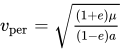
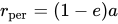
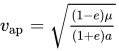
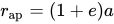
While, in accordance with Kepler's laws of planetary motion (based on the conservation of angular momentum) and the conservation of energy, these two quantities are constant for a given orbit:
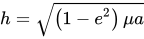

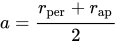
where:
- a is the semi-major axis:
- μ is the standard gravitational parameter
- e is the eccentricity, defined as
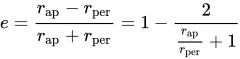
Note that for conversion from heights above the surface to distances between an orbit and its primary, the radius of the central body has to be added, and conversely.
The arithmetic mean of the two limiting distances is the length of the semi-major axis a. The geometric mean of the two distances is the length of the semi-minor axis b.
The geometric mean of the two limiting speeds is
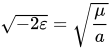
which is the speed of a body in a circular orbit whose radius is .

Time of perihelion[edit]
Orbital elements such as the time of perihelion passage are defined at the epoch chosen using an unperturbed two-body solution that does not account for the n-body problem. To get an accurate time of perihelion passage you need to use an epoch close to the perihelion passage. For example, using an epoch of 1996, Comet Hale–Bopp shows perihelion on 1 April 1997.[24] Using an epoch of 2008 shows a less accurate perihelion date of 30 March 1997.[25] Short-period comets can be even more sensitive to the epoch selected. Using an epoch of 2005 shows 101P/Chernykh coming to perihelion on 25 December 2005,[26] but using an epoch of 2012 produces a less accurate unperturbed perihelion date of 20 January 2006.[27]
Numerical integration shows dwarf planet Eris will come to perihelion around December 2257.[28] Using an epoch of 2021, which is 236 years early, less accurately shows Eris coming to perihelion in 2260.[29]
4 Vesta comes to perihelion on 26 December 2021,[30] but using a two-body solution at an epoch of July 2021 less accurately shows Vesta coming to perihelion on 25 December 2021.[31]
Short arcs[edit]
Trans-Neptunian objects discovered when 80+ AU from the Sun need dozens of observations over multiple years to well constrain their orbits because they move very slowly against the background stars. Due to statistics of small numbers, trans-Neptunian objects such as 2015 TH367 with only 8 observations over an observation arc of 1 year that have not or will not come to perihelion for roughly 100 years can have a 1-sigma uncertainty of 74.6 years (27,260 days) in the perihelion date.[32]
Axial precession

In astronomy, axial precession is a gravity-induced, slow, and continuous change in the orientation of an astronomical body's rotational axis. In particular, it can refer to the gradual shift in the orientation of Earth's axis of rotation in a cycle of approximately 26,000 years.[1] This is similar to the precession of a spinning top, with the axis tracing out a pair of cones joined at their apices. The term "precession" typically refers only to this largest part of the motion; other changes in the alignment of Earth's axis—nutation and polar motion—are much smaller in magnitude.
Earth's precession was historically called the precession of the equinoxes, because the equinoxes moved westward along the ecliptic relative to the fixed stars, opposite to the yearly motion of the Sun along the ecliptic. Historically,[2] the discovery of the precession of the equinoxes is usually attributed in the West to the 2nd-century-BC astronomer Hipparchus. With improvements in the ability to calculate the gravitational force between planets during the first half of the nineteenth century, it was recognized that the ecliptic itself moved slightly, which was named planetary precession, as early as 1863, while the dominant component was named lunisolar precession.[3] Their combination was named general precession, instead of precession of the equinoxes.
Lunisolar precession is caused by the gravitational forces of the Moon and Sun on Earth's equatorial bulge, causing Earth's axis to move with respect to inertial space. Planetary precession (an advance) is due to the small angle between the gravitational force of the other planets on Earth and its orbital plane (the ecliptic), causing the plane of the ecliptic to shift slightly relative to inertial space. Lunisolar precession is about 500 times greater than planetary precession.[4] In addition to the Moon and Sun, the other planets also cause a small movement of Earth's axis in inertial space, making the contrast in the terms lunisolar versus planetary misleading, so in 2006 the International Astronomical Union recommended that the dominant component be renamed the precession of the equator, and the minor component be renamed precession of the ecliptic, but their combination is still named general precession.[5] Many references to the old terms exist in publications predating the change.
Nomenclature[edit]

"Precession" and "procession" are both terms that relate to motion. "Precession" is derived from the Latin praecedere ("to precede, to come before or earlier"), while "procession" is derived from the Latin procedere ("to march forward, to advance"). Generally the term "procession" is used to describe a group of objects moving forward. The stars viewed from Earth are seen to proceed from east to west daily, due to the Earth's diurnal motion, and yearly, due to the Earth's revolution around the Sun. At the same time the stars can be observed to anticipate slightly such motion, at the rate of approximately 50 arc seconds per year, a phenomenon known as the "precession of the equinoxes".
In describing this motion astronomers generally have shortened the term to simply "precession". In describing the cause of the motion physicists have also used the term "precession", which has led to some confusion between the observable phenomenon and its cause, which matters because in astronomy, some precessions are real and others are apparent. This issue is further obfuscated by the fact that many astronomers are physicists or astrophysicists.
The term "precession" used in astronomy generally describes the observable precession of the equinox (the stars moving retrograde across the sky), whereas the term "precession" as used in physics, generally describes a mechanical process.
Effects[edit]

The precession of the Earth's axis has a number of observable effects. First, the positions of the south and north celestial poles appear to move in circles against the space-fixed backdrop of stars, completing one circuit in approximately 26,000 years. Thus, while today the star Polaris lies approximately at the north celestial pole, this will change over time, and other stars will become the "north star".[2] In approximately 3,200 years, the star Gamma Cephei in the Cepheus constellation will succeed Polaris for this position. The south celestial pole currently lacks a bright star to mark its position, but over time precession also will cause bright stars to become south stars. As the celestial poles shift, there is a corresponding gradual shift in the apparent orientation of the whole star field, as viewed from a particular position on Earth.
Secondly, the position of the Earth in its orbit around the Sun at the solstices, equinoxes, or other time defined relative to the seasons, slowly changes.[2] For example, suppose that the Earth's orbital position is marked at the summer solstice, when the Earth's axial tilt is pointing directly toward the Sun. One full orbit later, when the Sun has returned to the same apparent position relative to the background stars, the Earth's axial tilt is not now directly toward the Sun: because of the effects of precession, it is a little way "beyond" this. In other words, the solstice occurred a little earlier in the orbit. Thus, the tropical year, measuring the cycle of seasons (for example, the time from solstice to solstice, or equinox to equinox), is about 20 minutes shorter than the sidereal year, which is measured by the Sun's apparent position relative to the stars. After about 26 000 years the difference amounts to a full year, so the positions of the seasons relative to the orbit are "back where they started". (Other effects also slowly change the shape and orientation of the Earth's orbit, and these, in combination with precession, create various cycles of differing periods; see also Milankovitch cycles. The magnitude of the Earth's tilt, as opposed to merely its orientation, also changes slowly over time, but this effect is not attributed directly to precession.)
For identical reasons, the apparent position of the Sun relative to the backdrop of the stars at some seasonally fixed time slowly regresses a full 360° through all twelve traditional constellations of the zodiac, at the rate of about 50.3 seconds of arc per year, or 1 degree every 71.6 years.
At present, the rate of precession corresponds to a period of 25,772 years, so tropical year is shorter than sidereal year by 1,224.5 seconds (20 min 24.5 s, ~365.24219*86400/25772).
The rate itself varies somewhat with time (see Values below), so one cannot say that in exactly 25,772 years the Earth's axis will be back to where it is now.
For further details, see Changing pole stars and Polar shift and equinoxes shift, below.
History[edit]
Hellenistic world[edit]
Hipparchus[edit]
The discovery of precession usually is attributed to Hipparchus (190–120 BC) of Rhodes or Nicaea, a Greek astronomer. According to Ptolemy's Almagest, Hipparchus measured the longitude of Spica and other bright stars. Comparing his measurements with data from his predecessors, Timocharis (320–260 BC) and Aristillus (~280 BC), he concluded that Spica had moved 2° relative to the autumnal equinox. He also compared the lengths of the tropical year (the time it takes the Sun to return to an equinox) and the sidereal year (the time it takes the Sun to return to a fixed star), and found a slight discrepancy. Hipparchus concluded that the equinoxes were moving ("precessing") through the zodiac, and that the rate of precession was not less than 1° in a century, in other words, completing a full cycle in no more than 36000 years.[6]
Virtually all of the writings of Hipparchus are lost, including his work on precession. They are mentioned by Ptolemy, who explains precession as the rotation of the celestial sphere around a motionless Earth. It is reasonable to presume that Hipparchus, similarly to Ptolemy, thought of precession in geocentric terms as a motion of the heavens, rather than of the Earth.
Ptolemy[edit]
The first astronomer known to have continued Hipparchus's work on precession is Ptolemy in the second century AD. Ptolemy measured the longitudes of Regulus, Spica, and other bright stars with a variation of Hipparchus's lunar method that did not require eclipses. Before sunset, he measured the longitudinal arc separating the Moon from the Sun. Then, after sunset, he measured the arc from the Moon to the star. He used Hipparchus's model to calculate the Sun's longitude, and made corrections for the Moon's motion and its parallax (Evans 1998, pp. 251–255). Ptolemy compared his own observations with those made by Hipparchus, Menelaus of Alexandria, Timocharis, and Agrippa. He found that between Hipparchus's time and his own (about 265 years), the stars had moved 2°40', or 1° in 100 years (36" per year; the rate accepted today is about 50" per year or 1° in 72 years). It is possible, however, that Ptolemy simply trusted Hipparchus' figure instead of making his own measurements. He also confirmed that precession affected all fixed stars, not just those near the ecliptic, and his cycle had the same period of 36,000 years as found by Hipparchus.[6]
Other authors[edit]
Most ancient authors did not mention precession and, perhaps, did not know of it. For instance, Proclus rejected precession, while Theon of Alexandria, a commentator on Ptolemy in the fourth century, accepted Ptolemy's explanation. Theon also reports an alternate theory:
- According to certain opinions ancient astrologers believe that from a certain epoch the solstitial signs have a motion of 8° in the order of the signs, after which they go back the same amount. . . . (Dreyer 1958, p. 204)
Instead of proceeding through the entire sequence of the zodiac, the equinoxes "trepidated" back and forth over an arc of 8°. The theory of trepidation is presented by Theon as an alternative to precession.
Alternative discovery theories[edit]
Babylonians[edit]
Various assertions have been made that other cultures discovered precession independently of Hipparchus. According to Al-Battani, the Chaldean astronomers had distinguished the tropical and sidereal year so that by approximately 330 BC, they would have been in a position to describe precession, if inaccurately, but such claims generally are regarded as unsupported.[7]
Maya[edit]
The archaeologist Susan Milbrath has speculated that the Mesoamerican Long Count calendar of "30,000 years involving the Pleiades...may have been an effort to calculate the precession of the equinox."[8] This view is held by few other professional scholars of Mayan civilization.[citation needed]
Ancient Egyptians[edit]
Similar claims have been made that precession was known in Ancient Egypt during the dynastic era, prior to the time of Hipparchus (Ptolemaic period). However, these claims remain controversial. Some buildings in the Karnak temple complex, for instance, allegedly were oriented toward the point on the horizon where certain stars rose or set at key times of the year.[citation needed] Nonetheless, they kept accurate calendars and if they recorded the date of the temple reconstructions it would be a fairly simple matter to plot the rough precession rate. The Dendera Zodiac, a star-map from the Hathor temple at Dendera from a late (Ptolemaic) age, allegedly records precession of the equinoxes (Tompkins 1971). In any case, if the ancient Egyptians knew of precession, their knowledge is not recorded as such in any of their surviving astronomical texts.
Michael Rice wrote in his Egypt's Legacy, "Whether or not the ancients knew of the mechanics of the Precession before its definition by Hipparchos the Bithynian in the second century BC is uncertain, but as dedicated watchers of the night sky they could not fail to be aware of its effects." (p. 128) Rice believes that "the Precession is fundamental to an understanding of what powered the development of Egypt" (p. 10), to the extent that "in a sense Egypt as a nation-state and the king of Egypt as a living god are the products of the realisation by the Egyptians of the astronomical changes effected by the immense apparent movement of the heavenly bodies which the Precession implies." (p. 56). Rice says that "the evidence that the most refined astronomical observation was practised in Egypt in the third millennium BC (and probably even before that date) is clear from the precision with which the Pyramids at Giza are aligned to the cardinal points, a precision which could only have been achieved by their alignment with the stars. " (p. 31) The Egyptians also, says Rice, were "to alter the orientation of a temple when the star on whose position it had originally been set moved its position as a consequence of the Precession, something which seems to have happened several times during the New Kingdom." (p. 170)
India[edit]
Before 1200, India had two theories of trepidation, one with a rate and another without a rate, and several related models of precession. Each had minor changes or corrections by various commentators. The dominant of the three was the trepidation described by the most respected Indian astronomical treatise, the Surya Siddhanta (3:9–12), composed c. 400 but revised during the next few centuries. It used a sidereal epoch, or ayanamsa, that is still used by all Indian calendars, varying over the ecliptic longitude of 19°11′ to 23°51′, depending on the group consulted.[9] This epoch causes the roughly 30 Indian calendar years to begin 23–28 days after the modern vernal equinox. The vernal equinox of the Surya Siddhanta librated 27° in both directions from the sidereal epoch. Thus the equinox moved 54° in one direction and then back 54° in the other direction. This cycle took 7200 years to complete at a rate of 54″/year. The equinox coincided with the epoch at the beginning of the Kali Yuga in −3101 and again 3600 years later in 499. The direction changed from prograde to retrograde midway between these years at −1301 when it reached its maximum deviation of 27°, and would have remained retrograde, the same direction as modern precession, for 3600 years until 2299.[10][11]: 29–30
Another trepidation was described by Varāhamihira (c. 550). His trepidation consisted of an arc of 46°40′ in one direction and a return to the starting point. Half of this arc, 23°20′, was identified with the Sun's maximum declination on either side of the equator at the solstices. But no period was specified, thus no annual rate can be ascertained.[11]: 27–28
Several authors have described precession to be near 200,000 revolutions in a Kalpa of 4,320,000,000 years, which would be a rate of 200,000×360×36004,320,000,000 = 60″/year. They probably deviated from an even 200,000 revolutions to make the accumulated precession zero near 500. Visnucandra (c. 550–600) mentions 189,411 revolutions in a Kalpa or 56.8″/year. Bhaskara I (c. 600–680) mentions [1]94,110 revolutions in a Kalpa or 58.2″/year. Bhāskara II (c. 1150) mentions 199,699 revolutions in a Kalpa or 59.9″/year.[11]: 32–33
Chinese astronomy[edit]
Yu Xi (fourth century AD) was the first Chinese astronomer to mention precession. He estimated the rate of precession as 1° in 50 years (Pannekoek 1961, p. 92).
Middle Ages and Renaissance[edit]
In medieval Islamic astronomy, precession was known based on Ptolemy's Almagest, and by observations that refined the value.
Al-Battani, in his Zij Al-Sabi', after mentioning Hipparchus calculating precession, and Ptolemy's value of 1 degree per 100 solar years, says that he measured precession and found it to be one degree per 66 solar years.[12]
Subsequently, Al-Sufi mentions the same values in his Book of Fixed Stars, that Ptolemy's value for precession is 1 degree per 100 solar years. He then quotes a different value from Zij Al Mumtahan, which was done during Al-Ma'mun's reign, as 1 degree for every 66 solar years. He also quotes the aforementioned Al-Battani's Zij Al-Sabi' as adjusting coordinates for stars by 11 degrees and 10 minutes of arc to account for the difference between Al-Battani's time and Ptolemy's.[13]
Later, the Zij-i Ilkhani compiled at the Maragheh observatory sets the precession of the equinoxes at 51 arc seconds per annum, which is very close to the modern value of 50.2 arc seconds.[14]
In the Middle Ages, Islamic and Latin Christian astronomers treated "trepidation" as a motion of the fixed stars to be added to precession. This theory is commonly attributed to the Arab astronomer Thabit ibn Qurra, but the attribution has been contested in modern times. Nicolaus Copernicus published a different account of trepidation in De revolutionibus orbium coelestium (1543). This work makes the first definite reference to precession as the result of a motion of the Earth's axis. Copernicus characterized precession as the third motion of the Earth.[15]
Modern period[edit]
Over a century later precession was explained in Isaac Newton's Philosophiae Naturalis Principia Mathematica (1687), to be a consequence of gravitation (Evans 1998, p. 246). Newton's original precession equations did not work, however, and were revised considerably by Jean le Rond d'Alembert and subsequent scientists.
Hipparchus's discovery[edit]
Hipparchus gave an account of his discovery in On the Displacement of the Solsticial and Equinoctial Points (described in Almagest III.1 and VII.2). He measured the ecliptic longitude of the star Spica during lunar eclipses and found that it was about 6° west of the autumnal equinox. By comparing his own measurements with those of Timocharis of Alexandria (a contemporary of Euclid, who worked with Aristillus early in the 3rd century BC), he found that Spica's longitude had decreased by about 2° in the meantime (exact years are not mentioned in Almagest). Also in VII.2, Ptolemy gives more precise observations of two stars, including Spica and concludes that in each case a 2°:40' change occurred between 128 BC and AD 139 (hence, 1° per century or one full cycle in 36000 years, that is, the precessional period of Hipparchus as reported by Ptolemy ; cf. page 328 in Toomer's translation of Almagest, 1998 edition)). He also noticed this motion in other stars. He speculated that only the stars near the zodiac shifted over time. Ptolemy called this his "first hypothesis" (Almagest VII.1), but did not report any later hypothesis Hipparchus might have devised. Hipparchus apparently limited his speculations, because he had only a few older observations, which were not very reliable.
Because the equinoctial points are not marked in the sky, Hipparchus needed the Moon as a reference point; he used a lunar eclipse to measure the position of a star. Hipparchus already had developed a way to calculate the longitude of the Sun at any moment. A lunar eclipse happens during Full moon, when the Moon is at opposition, precisely 180° from the Sun. Hipparchus is thought to have measured the longitudinal arc separating Spica from the Moon. To this value, he added the calculated longitude of the Sun, plus 180° for the longitude of the Moon. He did the same procedure with Timocharis' data (Evans 1998, p. 251). Observations such as these eclipses, incidentally, are the main source of data about when Hipparchus worked, since other biographical information about him is minimal. The lunar eclipses he observed, for instance, took place on 21 April 146 BC, and 21 March 135 BC (Toomer 1984, p. 135 n. 14).
Hipparchus also studied precession in On the Length of the Year. Two kinds of year are relevant to understanding his work. The tropical year is the length of time that the Sun, as viewed from the Earth, takes to return to the same position along the ecliptic (its path among the stars on the celestial sphere). The sidereal year is the length of time that the Sun takes to return to the same position with respect to the stars of the celestial sphere. Precession causes the stars to change their longitude slightly each year, so the sidereal year is longer than the tropical year. Using observations of the equinoxes and solstices, Hipparchus found that the length of the tropical year was 365+1/4−1/300 days, or 365.24667 days (Evans 1998, p. 209). Comparing this with the length of the sidereal year, he calculated that the rate of precession was not less than 1° in a century. From this information, it is possible to calculate that his value for the sidereal year was 365+1/4+1/144 days (Toomer 1978, p. 218). By giving a minimum rate, he may have been allowing for errors in observation.
To approximate his tropical year Hipparchus created his own lunisolar calendar by modifying those of Meton and Callippus in On Intercalary Months and Days (now lost), as described by Ptolemy in the Almagest III.1 (Toomer 1984, p. 139). The Babylonian calendar used a cycle of 235 lunar months in 19 years since 499 BC (with only three exceptions before 380 BC), but it did not use a specified number of days. The Metonic cycle (432 BC) assigned 6,940 days to these 19 years producing an average year of 365+1/4+1/76 or 365.26316 days. The Callippic cycle (330 BC) dropped one day from four Metonic cycles (76 years) for an average year of 365+1/4 or 365.25 days. Hipparchus dropped one more day from four Callippic cycles (304 years), creating the Hipparchic cycle with an average year of 365+1/4−1/304 or 365.24671 days, which was close to his tropical year of 365+1/4−1/300 or 365.24667 days.
Hipparchus's mathematical signatures are found in the Antikythera Mechanism, an ancient astronomical computer of the second century BC. The mechanism is based on a solar year, the Metonic Cycle, which is the period the Moon reappears in the same place in the sky with the same phase (full Moon appears at the same position in the sky approximately in 19 years), the Callipic cycle (which is four Metonic cycles and more accurate), the Saros cycle and the Exeligmos cycles (three Saros cycles for the accurate eclipse prediction). The study of the Antikythera Mechanism proves that the ancients have been using very accurate calendars based on all the aspects of solar and lunar motion in the sky. In fact, the Lunar Mechanism which is part of the Antikythera Mechanism depicts the motion of the Moon and its phase, for a given time, using a train of four gears with a pin and slot device which gives a variable lunar velocity that is very close to the second law of Kepler, i.e. it takes into account the fast motion of the Moon at perigee and slower motion at apogee. This discovery proves that Hipparchus mathematics were much more advanced than Ptolemy describes in his books, as it is evident that he developed a good approximation of Kepler's second law.


Comments
Post a Comment
Have something to say? Say it See it Feel it Live it then take It apart until you know what It is and As you were before you were born, feel the sound of it rattling around in the outbox smell the sight of it as the juices in your brain bag are fed little light waves of electric combinatory discombinatory salty sea solution sliding stealthily supplying the juice for the other end of the switch turned on by the turn on that turns on the on like one is when one is on and one is when one is idling on as the slumber soothes silky roads of well traversed travelers traipsing trails of tuned toned teeny tiny twirls of primes pumping nines into sixes and threes like humming honey bees evens evening out the odds as the unknown unknowns puddle sing a shiny bling and bring the ear funnel Z as close as eyeball close can see...z.z..z...