Calcu less in G the h ypo ten use from the 3600 anglenoose using the Geo met h er g(())see sea
Calculating the hypotenuse[edit source]

The length of the hypotenuse can be calculated using the square root function implied by the Pythagorean theorem. Using the common notation that the length of the two legs of the triangle (the sides perpendicular to each other) are a and b and that of the hypotenuse is c, we have

The Pythagorean theorem, and hence this length, can also be derived from the law of cosines by observing that the angle opposite the hypotenuse is 90° and noting that its cosine is 0:

Many computer languages support the ISO C standard function hypot(x,y), which returns the value above.[5] The function is designed not to fail where the straightforward calculation might overflow or underflow and can be slightly more accurate and sometimes significantly slower.
Some scientific calculators[which?] provide a function to convert from rectangular coordinates to polar coordinates. This gives both the length of the hypotenuse and the angle the hypotenuse makes with the base line (c1 above) at the same time when given x and y. The angle returned is normally given by atan2(y,x).
Trigonometric ratios[edit source]
By means of trigonometric ratios, one can obtain the value of two acute angles, and , of the right triangle.


Given the length of the hypotenuse and of a cathetus , the ratio is:


The trigonometric inverse function is:
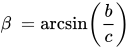
in which is the angle opposite the cathetus .
The adjacent angle of the catheti is = 90° –
One may also obtain the value of the angle by the equation:
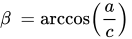
in which is the other cathetus.

Cathetus

In a right triangle, a cathetus (originally from the Greek word Κάθετος; plural: catheti), commonly known as a leg, is either of the sides that are adjacent to the right angle. It is occasionally called a "side about the right angle". The side opposite the right angle is the hypotenuse. In the context of the hypotenuse, the catheti are sometimes referred to simply as "the other two sides".
If the catheti of a right triangle have equal lengths, the triangle is isosceles. If they have different lengths, a distinction can be made between the minor (shorter) and major (longer) cathetus. The ratio of the lengths of the catheti defines the trigonometric functions tangent and cotangent of the acute angles in the triangle: the ratio is the tangent of the acute angle adjacent to and is also the cotangent of the acute angle adjacent to .


In a right triangle, the length of a cathetus is the geometric mean of the length of the adjacent segment cut by the altitude to the hypotenuse and the length of the whole hypotenuse.
By the Pythagorean theorem, the sum of the squares of the lengths of the catheti is equal to the square of the length of the hypotenuse.
The term leg, in addition to referring to a cathetus of a right triangle, is also used to refer to either of the equal sides of an isosceles triangle or to either of the non-parallel sides of a trapezoid.
In architecture, the term cathetus has been used for the eye of the volute. It was so termed because its position is determined, in an Ionic (or voluted) capital, by a line let down from the point in which the volute generates.[1]
Molten salt reactor

A molten salt reactor (MSR) is a class of nuclear fission reactor in which the primary nuclear reactor coolant and/or the fuel is a molten salt mixture. Only two MSRs have ever operated, both research reactors in the United States. The 1950's Aircraft Reactor Experiment was primarily motivated by the compact size that the technique offers, while the 1960's Molten-Salt Reactor Experiment aimed to prove the concept of a nuclear power plant which implements a thorium fuel cycle in a breeder reactor. Increased research into Generation IV reactor designs began to renew interest in the technology, with multiple nations having projects, and as of September 2021, China is on the verge of starting its TMSR-LF1 thorium MSR.[1][2]
MSRs are considered safer than conventional reactors because they operate with fuel already in a molten state, and in event of an emergency, the fuel mixture is designed to drain from the core to a containment vessel where it will solidify in fuel drain tanks. This prevents the uncontrolled nuclear meltdown and associated hydrogen explosions (as in the Fukushima nuclear disaster) that are a risk in conventional (solid-fuel) reactors.[2] They operate at or close to atmospheric pressure, rather than the 75-150 times atmospheric pressure of a typical light-water reactor (LWR), hence reducing the need for large, expensive reactor pressure vessels used in LWRs. Another advantage of MSRs is that the gaseous fission products (Xe and Kr) do not have much solubility in the fuelsalt,[a] and can be safely captured as they bubble out of the molten fuel,[b] rather than increasing the pressure inside the fuel tubes over the life of the fuel, as happens in conventional solid-fuelled reactors. MSR's can also be refueled while operating (essentially online-nuclear reprocessing) while conventional reactors must be shut down for refueling (Pressure tube heavy water reactors like the CANDU or the Atucha-class PHWRs, and British-built Gas-cooled Reactors (Magnox, AGR) being notable exceptions).
A further key characteristic of MSRs is operating temperatures of around 700 °C (1,292 °F), significantly higher than traditional LWRs at around 300 °C (572 °F), providing greater electricity-generation efficiency, the possibility of grid-storage facilities, economical hydrogen production, and, in some cases, process-heat opportunities. Relevant design challenges include the corrosivity of hot salts and the changing chemical composition of the salt as it is transmuted by the neutron flux in the reactor core.
MSRs offer multiple advantages over conventional nuclear power plants, although for historical reasons they have not been deployed.
Orbital period
| Part of a series on |
| Astrodynamics |
|---|
 |
The orbital period (also revolution period) is the amount of time a given astronomical object takes to complete one orbit around another object. In astronomy, it usually applies to planets or asteroids orbiting the Sun, moons orbiting planets, exoplanets orbiting other stars, or binary stars.
For celestial objects in general, the sidereal period (sidereal year) is referred to by the orbital period, determined by a 360° revolution of one body around its primary, e.g. Earth around the Sun, relative to the fixed stars projected in the sky. Orbital periods can be defined in several ways. The tropical period is more particularly about the position of the parent star. It is the basis for the solar year, and respectively the calendar year.
The synodic period incorporates not only the orbital relation to the parent star, but also to other celestial objects, making it not a mere different approach to the orbit of an object around its parent, but a period of orbital relations with other objects, normally Earth and their orbits around the Sun. It applies to the elapsed time where planets return to the same kind of phenomena or location, such as when any planet returns between its consecutive observed conjunctions with or oppositions to the Sun. For example, Jupiter has a synodic period of 398.8 days from Earth; thus, Jupiter's opposition occurs once roughly every 13 months.
Periods in astronomy are conveniently expressed in various units of time, often in hours, days, or years. They can be also defined under different specific astronomical definitions that are mostly caused by the small complex external gravitational influences of other celestial objects. Such variations also include the true placement of the centre of gravity between two astronomical bodies (barycenter), perturbations by other planets or bodies, orbital resonance, general relativity, etc. Most are investigated by detailed complex astronomical theories using celestial mechanics using precise positional observations of celestial objects via astrometry.
Three-dimensional space
 | This article includes a list of general references, but it lacks sufficient corresponding inline citations. (April 2016) |

Three-dimensional space (also: 3D space, 3-space or, rarely, tri-dimensional space) is a geometric setting in which three values (called parameters) are required to determine the position of an element (i.e., point). This is the informal meaning of the term dimension.
In mathematics, a tuple of n numbers can be understood as the Cartesian coordinates of a location in a n-dimensional Euclidean space. The set of these n-tuples is commonly denoted and can be identified to the n-dimensional Euclidean space. When n = 3, this space is called three-dimensional Euclidean space (or simply Euclidean space when the context is clear).[1] It serves as a model of the physical universe (when relativity theory is not considered), in which all known matter exists. While this space remains the most compelling and useful way to model the world as it is experienced,[2] it is only one example of a large variety of spaces in three dimensions called 3-manifolds. In this classical example, when the three values refer to measurements in different directions (coordinates), any three directions can be chosen, provided that vectors in these directions do not all lie in the same 2-space (plane). Furthermore, in this case, these three values can be labeled by any combination of three chosen from the terms width/breadth, height/depth, and length.


Comments
Post a Comment
Have something to say? Say it See it Feel it Live it then take It apart until you know what It is and As you were before you were born, feel the sound of it rattling around in the outbox smell the sight of it as the juices in your brain bag are fed little light waves of electric combinatory discombinatory salty sea solution sliding stealthily supplying the juice for the other end of the switch turned on by the turn on that turns on the on like one is when one is on and one is when one is idling on as the slumber soothes silky roads of well traversed travelers traipsing trails of tuned toned teeny tiny twirls of primes pumping nines into sixes and threes like humming honey bees evens evening out the odds as the unknown unknowns puddle sing a shiny bling and bring the ear funnel Z as close as eyeball close can see...z.z..z...